
A website is important for the success of your business in the online world. A well-created website is an effective platform to showcase your business offerings, build online credibility, engage potential customers, and gain a competitive edge.
Besides these, it can help you reach a wide audience that you might have missed before. One recent report stated that: over 5.56 billion, roughly 67.9% of the global population,use the Internet in 2025.
In this scenario, many of your digitally savvy customers are likely searching for your business online, making a website a crucial tool for success.
Knowing the importance of a business website, you might be thinking about how to create a website for your business. We have crafted this post to comprehensively explain minor to major details about building a website for business effectively.
Why create A website for your business?
Every business deserves a website, whether it is growing or developing. It offers several advantages that can improve the presence and growth of your business:
- On a business website, you can provide detailed information about your products and services. You can showcase images, write descriptions, and list the prices of your offerings.
- With a website, you can attract a wide audience beyond your local area.
- Blogs, new updates, contact forms, and newsletters on your website play a vital role in keeping customers engaged with your business.
- A website allows customers to access details about your business offerings, anytime and anywhere.
A step-by-step guide to building a website for your business
In the below sections, we have explained a step-by-step process to help you create a website for business.
1: Determine the Purpose of Your Website
Before starting to build a website for your business, it is important to determine its purpose first. Doing so will give you a clear direction throughout the development process and ensure that your site is created to achieve the business objectives.
To define your business website’s purpose, you should know the goals or objectives that you want to achieve with the site, such as:
- Generate leads.
- Sell Products and Services.
- Build your brand awareness.
- Educate the audience about your offerings.
Determining your goals clearly will ensure that your website is designed with the right features, pages, and functionalities, tailored to your business needs.
2: Choose a suitable domain and host your website
Your domain (e.g. itsbusiness.org)is your website’s address. Buying a domain name is a must for creating a website. For this, you can go to a domain registrar like GoDaddy, CloudFlare, NameCheap, etc., and claim a domain name.
You should be careful about choosing the domain name for your site. Some things to keep in mind here are followed:
- A domain name should be simple and easier to remember for users.
- It should reflect the name or offerings of your business.
- Avoid longer and more difficult words for the domain name.
- If possible, add your main keyword in the name.
- Your domain name must be unique.
For Example:
- If your business offers digital marketing services, then a relevant domain name might be Boostyourbrand.com or SEOgurushub.com.
- Similarly, if your business sells clothes, domain names like trendyclothes.com or urbanwearhub.com would be better.
After finalizing a domain name, it’s time to find a suitable web hosting provider to host your site. To select a hosting provider, you should consider factors such as: your website’s expected traffic, desired features, required storage, pricing plans, etc.
Some popular web hosting providers are;
- NameCheap.
- Bluehost.
- HostGato.
- Hostinger.
3: Start building your website
Now comes the actual stage of building your business website. This process involves the following considerations.
Choosing a website builder
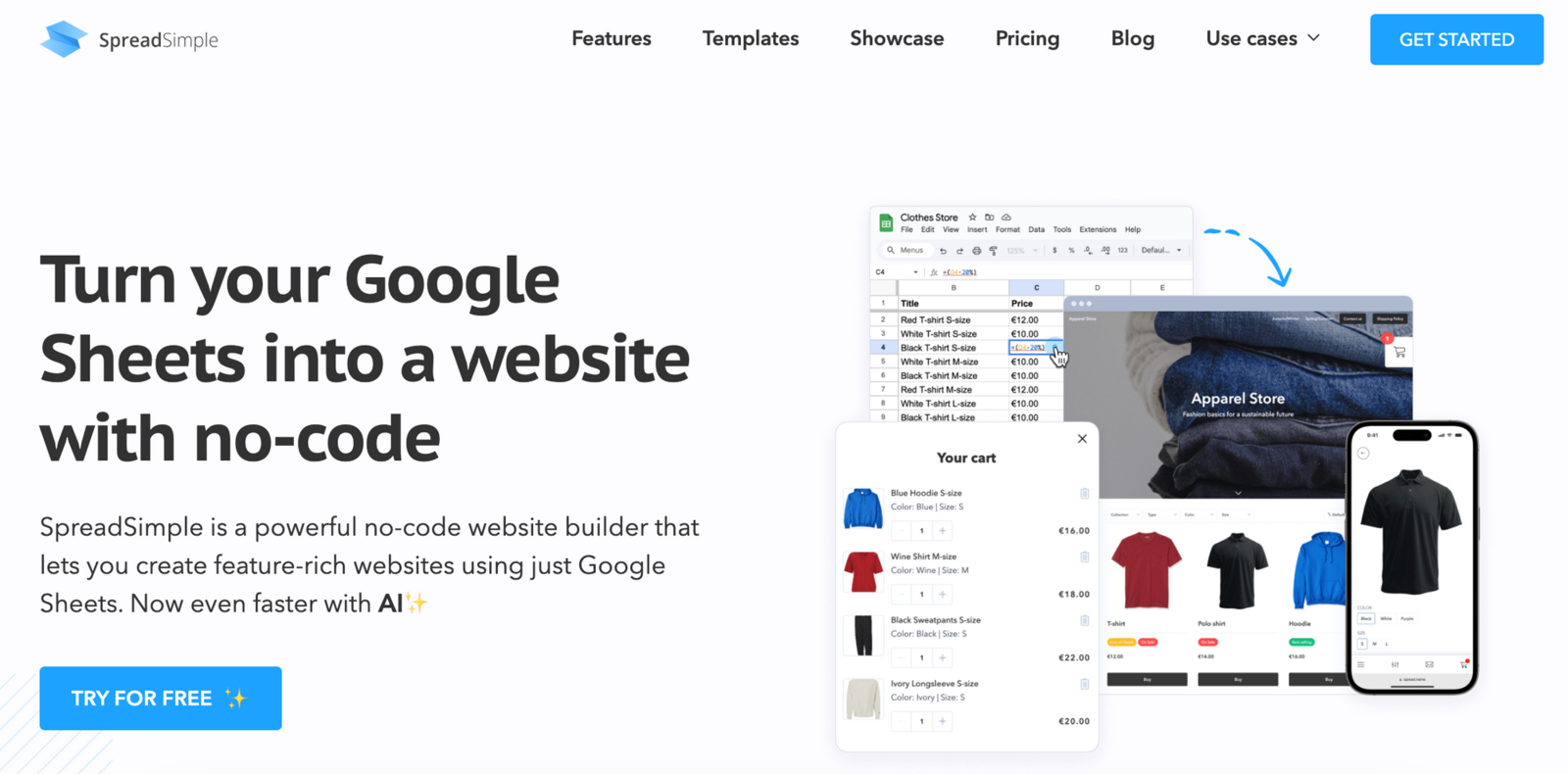
Select a suitable website builder platform that perfectly aligns with your needs. Here, considering user interface, design flexibility, availability of features, and pricing will help you choose the better option. Some popular options include: SpreadSimple, Wix, Wordpress, Shopify, etc.
SpreadSimple is one of the more straightforward options, allowing you to build a website completely no-code and manage it in Google Sheets. This tool provides the perfect balance of simplicity and flexibility. You can build your website using AI or pre-made templates and fill it in with your content in just a couple of hours.
However, the use of AI and pre-designed templates does not mean that your website won't stand out. SpreadSimple provides enough space for your creativity: you can add and remove features, choose the layout, and connect add-ons to make your web page look one of a kind.
Layout Design
Plan the layout design of your website, such as the arrangement of headers, tables, content sections, footer, and navigational menus. Whatever layout structure you choose should be user-friendly and easier to navigate.
Integration of Different Features
You should add mandatory features on the site according to your business goals. It includes: contact forms, blog sections, image galleries, online store functionality, social media integration, chat support, and more
4. Write the home page content of your website
Content is among the most crucial parts of your business website. It plays a vital role in building credibility, keeping users engaged, as well as boosting search engine visibility.
First off,you need to write the home page or main page content of your website. Remember, the homepage is the first impression readers get about your business. So, it should be written very carefully. Your website’s main page content should clearly explain;
- Who are you?
- What are your business offerings?
- Why should your customers choose you?
- What makes your products or services unique?
While crafting home page content, you should avoid overwhelming your readers with unwanted information. Try to write as concisely as possible to value the time of visitors while providing key information.
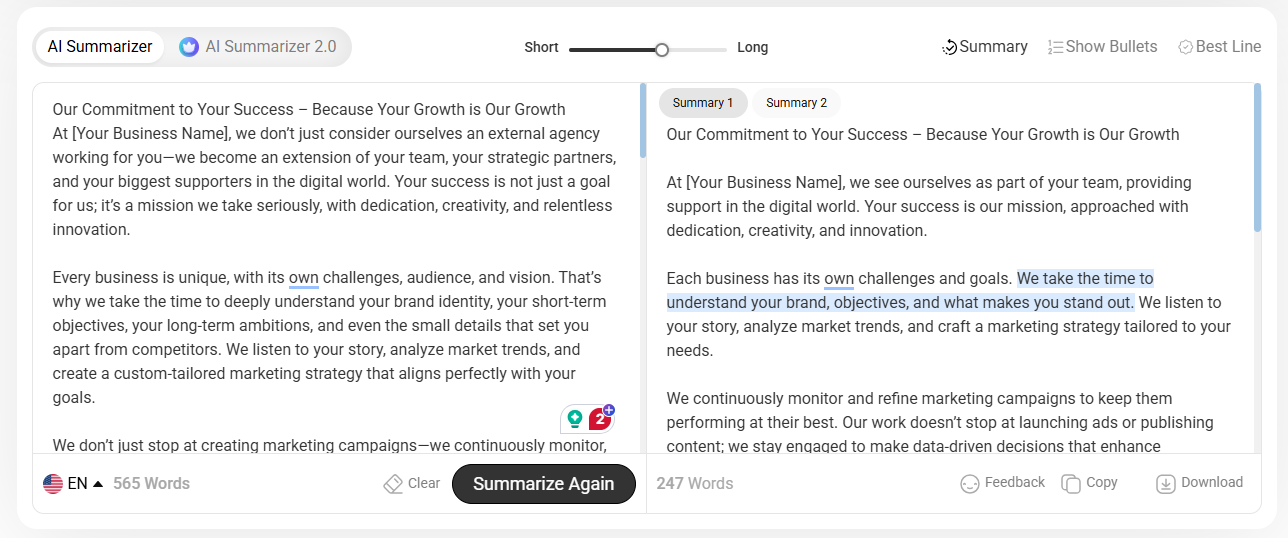
However, if you could not write briefly in the first draft, consider using AI summarizer to concise your content around its key information. It will automatically remove unnecessary details from your content and provide a to the point and coherent output.
For example, we summarized home page content using an AI Summarizing tool. It automatically removed extra details and wordiness from our writing and provided a concise output.
Here’s the demonstration:
Apart from the home page, you should write some other pages, including the About, Privacy Policy, Blog and Contact pages. On the blog page, you should regularly write high-quality blog posts to educate readers, solve their problems, and introduce your offerings.
5: SEO optimize your website
SEO, search engine pptimization, refers to the process of optimizing multiple factors of a website to make it rank higher in the SERPs. The higher your site ranks, the greater will be its visibility, and ultimately the organic traffic of your business website will increase. Below are some best practices to optimize your site for SEO.
Keywords research:
Find keywords relevant to your business for which you want to appear in search results. Using keyword research tools like Google Keywords Planner, Answer the Public, etc., can simplify this task.
Optimize meta-tags:
Adjust your target keywords in the titles and meta-descriptions of your pages. Ensure they are clear and engaging to read.
Add image Alt-tags:
Make sure that every image on your website contains a descriptive Alt-tag. It helps search engine crawlers understand what’s depicted in the images.
Internal and external linking:
Include internal links to the relevant pages of your website. Similarly, you should use external links to connect your pages with other valuable resources.
Utilize SEO tools:
Use SEO tools such as Google Search Console and Google Analytics to track the performance of your business website and make improvements accordingly.
6: Make your website mobile friendly
Your business website needs to be mobile-friendly because the majority of users now come from mobile devices. According to Statista: In January 2025, over 62% of total web traffic came from mobile devices excluding tablets.
In light of the above report, if your business website is not mobile-friendly, you are at risk of losing a large portion of your audience.
Follow these below-listed tips to make your website mobile-friendly:
- The site should have a responsive design that will automatically adapt to different screen sizes and resolutions. Choose a website builder that supports responsive design. For example, all websites built with SpreadSimple have responsive design by default and always look good on mobile.
- Consider improving your website’s loading speed and performance by minimizing HTML, JS, and CSS codes.
- You should reduce the sizes of images and videos to make them load faster on mobile devices.
- We suggest simplifying the overall website navigation for mobile users.
- Choose appropriate font types and sizes that are readable on mobile phones without zooming.
- Make sure that the videos on your site are mobile-compatible.
End talk
Building a business website is important for the success of your business in the digital landscape. A well-crafted site can help you enhance visibility, reach a wider audience, build trust, and more. In this blog post, we explained a step-by-step process to create your business website. These include: determining goals, buying a domain, building a website, crafting high-quality content, SEO optimizing, and making your website mobile-friendly. Now, it’s your turn to build your business website following this step-by-step guide.