
Building a website has become easier than ever nowadays. Thanks to so many applications, a huge number of templates, images, texts, etc., are available to help with the creation process. But even with the best tools the steps can take a good amount of time to add content, streamline your web pages, and organize the website's design. Now, let us welcome the latest craze on the Internet today – AI (artificial intelligence).
This newest development expands the boundaries of what is possible every day. Even website builders are jumping on the bandwagon to incorporate it into every stage of the creation process.
Though AI-powered website builders tools have been there for a few years already, the launch of ChatGPT has gotten people excited about the possibilities of AI in creating online content. Though such tools have always over-promised and under-delivered in the past, we do happen to have a small but amazing range of AI website builders available to the public. Many of these assist in creating fully functional, beautiful, and easy-to-use platforms quickly with minimum input. So if you are intrigued by the above idea and curious about these modern tools then read on to find out about the most popular AI web builders on the market.
What are AI website builders?
An AI website builder is primarily a tool that uses artificial intelligence to simplify the web and landing page creation process. It functions by taking input from users through prompts and then generating design suggestions to suit the client's preferred needs.
AI builders can help generate content and organize the whole layout of your platform making the process efficient and easy for anyone without any coding or designing skills. Some of these applications offer an option to connect to social media profiles like Facebook, Instagram, and Google My Business, from which they determine the ideal images, logo, and content for your professional website. AI builders also work well for niche sites — see our guide to auto dealer websites.
Some of the huge benefits that come with using AI in the platform creation process are:
- Enabling users to make a feature-rich website
- Eeasy to get the results you desire and need
- Building a fully customized platform
- Offering a great overall user experience
Top 9 AI Website Builders
In 2024, many new applications help users build a website powered with AI. They all have their advantages and different uses that provide customers with varying levels of control and assistance during the building procedure. We will dive into the top AI builders and explain their best features, how they assist users and what sets them apart. Whether you are looking for a quick setup module, unique design elements, or automated context, these AI-powered builders have something for every type of website.
1. SpreadSimple
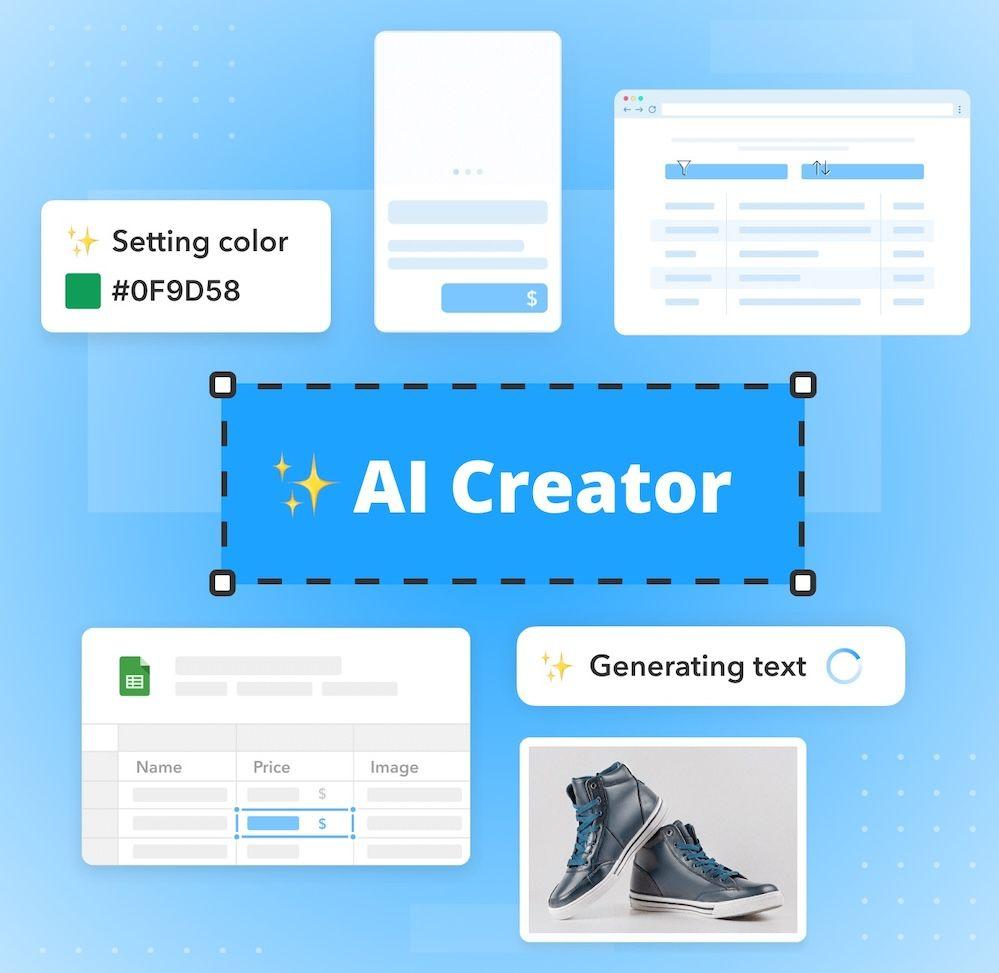
SpreadSimple is the latest entrant into the AI market, but it has been a veteran in the field of no-code website builders. The application offers its users a chance to create a feature-rich online store using just Google Sheets.
The highlight is that the spreadsheet functions as a content management system (CMS) for the platform, which means you can update your product information in just a few clicks by editing your sheet. Now, with the addition of AI, the work has become easier and faster, and customers can generate a website, design the web page layout, and fill up the content in a matter of minutes without any coding, designing, or copywriting skills.
The system works as follows:
- Start by writing a prompt describing your required website. Include details, such as preferred colors, layout, business type, etc.
- Press the Generate button and preview your website before actually launching it.
- SpreadSimple's AI will not only make your website, but will also design a logo, and page layout, and fill your Google Sheet with content based on the imputed prompt.
- Edit the spreadsheet content with real product information, like goods provided, pricing, services rendered, etc.
- If you do not like the design, feel free to try out other prompts till you find the ideal one to match your brand identity.
Some of the unique features that SpreadSimple’s AI offers are:
- It automatically generates the website in just a few minutes and lets the users get a preview of the final look of the platform.
Easy customization options where the users can change the logo, color, design, content, etc, to match their brand’s requirements. - It offers complete control over the site and allows for easy third-party integration services like payment systems, emails, social media channels, analytics tools, chat, and more.
- The website is already optimized for SEO so it will rank higher on SERPS, as well as has a fully responsive design that is compatible with mobile devices.
- The generated web pages are user-friendly and include different characteristics, such as advanced navigation settings, promo codes, shopping carts, flexible order forms, and integrations with online tools.
- With SpreadSimple, you can build a variety of websites, including affiliates, job boards, tourist guides, grocery stores, video catalogs, delivery services, listings and directories, real estate, and e-commerce.
- Pricing – From $12.90 to $20.90 per month with an annual billing cycle
- Free Plan – Available
- Best for – First-time entrepreneurs and new entrants into the online world

2. Wix
Wix is one of the top-rated AI website builders for 2024, as it was one of the first tools to adopt this system by integrating ADI (Artificial Design Intelligence) functions in 2016. It helps users create a personal website based on their answers from a quick questionnaire. The application manages to balance functionality and usability with its drag-and-drop interface, variety of designs, and powerful Wix ADI. You start by answering questions on a chatbot and telling it the requirements of your website. Except for a few missed requests, Wix manages to create a feature-rich platform for every type of user. However, you do need to change the stock text and images to match your brand and content. In recent years, they have also added some more AI features.
AI portfolio creator – In this, a user just uploads images and assets for a portfolio, and the AI generates descriptions and groups for each project. The feature is great for creative industries like photography.
- AI text creator – Wix also uses a ChatGPT to create three text (content) options in different styles based on the input. This feature saves valuable time and effort in filling up the web pages individually.
- AI section generator – The individual AI section generator can understand the suitable style from existing sections and help make web pages such as the About Us and Contacts web pages.
- AI email generator – With this Wix feature a business can send emails directly from their website and get more traffic in return. It is a great tool for boosting customer engagement and also frees up time to work on more relevant matters.
- AI SEO assistant – The AI SEO assistant can suggest personalized changes and quick fixes to your website that will improve your site’s visibility and ranking. It can also give optimal meta tags for your web pages.
- AI image creator – Generate images using AI by just giving it the right prompts. The feature also allows editing options, such as auto-enhancing the quality of the pictures and erasing objects.
- AI product support – As we mentioned earlier, the product support helps craft item descriptions that are keywords optimized for you to choose from. This helps nudge the target audience towards related goods and services and boost sales.
Overall, the Wix AI creator is always adding new features to its existing arsenal, making it easy for anyone to start a top-notch website with an option to tweak the content as per your preference.
- Pricing – from $199 to $1599 per month with an annual billing cycle
- Free Plan – not available
- Best for – All types of beginners, and also integration with ChatGPT
3. Framer
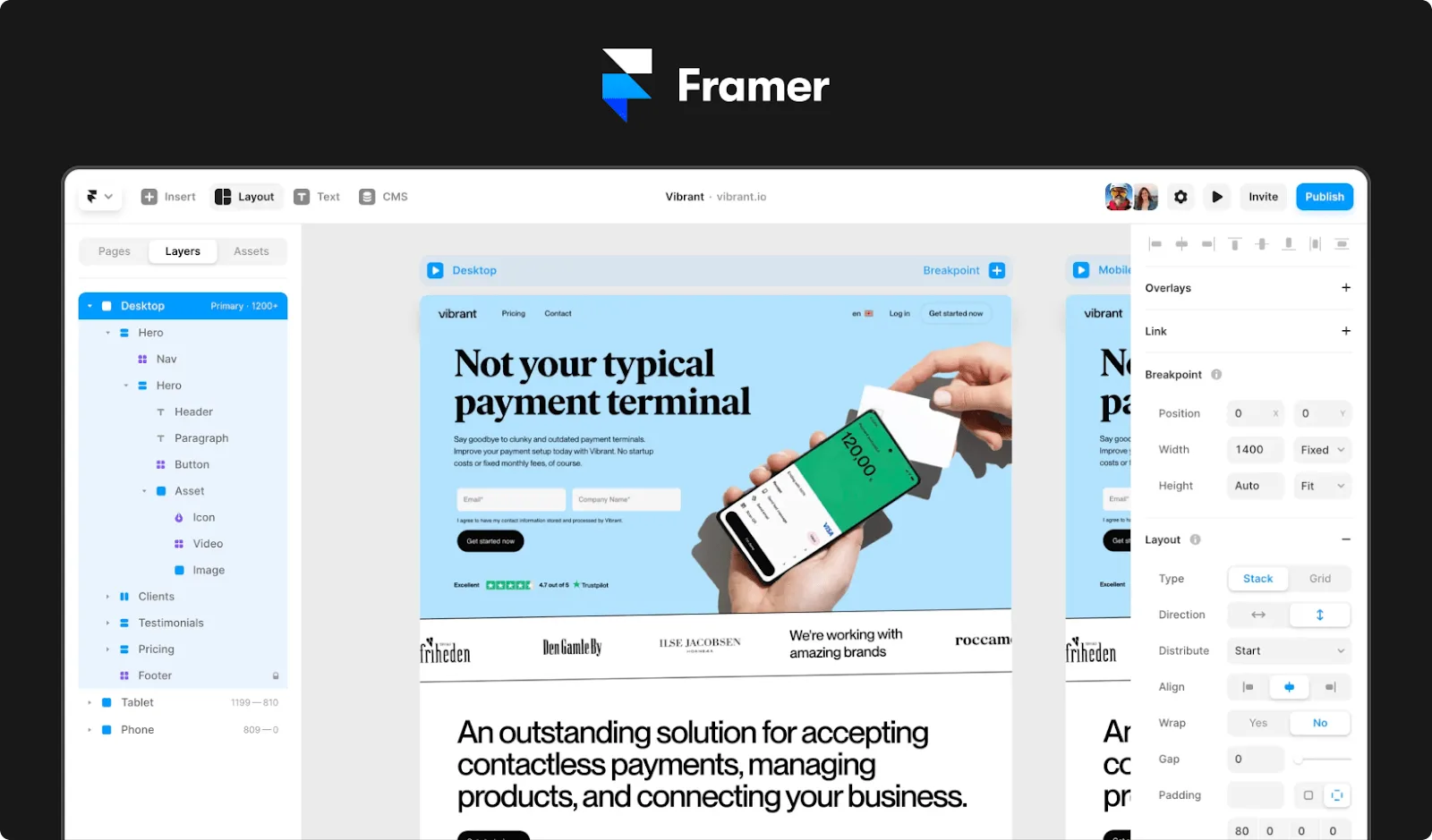
Our next tool, Framer is an AI-powered design application that quickly creates interactive and easy-to-use websites. It helps combine the flexibility of a design interface with AI suggestions to streamline the web page creation process. The builder is great for small businesses and designers who like to experiment with different layouts and interactions as it suggests many elements that save users lots of time and effort.
A few of Framer’s feature highlights include:
- A seamless multilingual experience with AI translation
- Polished content with AI text rewrite
- Customized styling with AI to match your brand identity and design
All in all, Framer is a wonderful software for seasoned creators and provides amazing value for money. Though it is a little basic in its functioning as compared to other tools in the market, it does provide a great foundation for the initial setup process.
- Pricing – Starting from €5 to €30 for personal and from €75 to over €200 for business enterprises
- Free Plan – free trial available
- Best for – For seasoned designers, integration with OpenAI
4. Jimdo
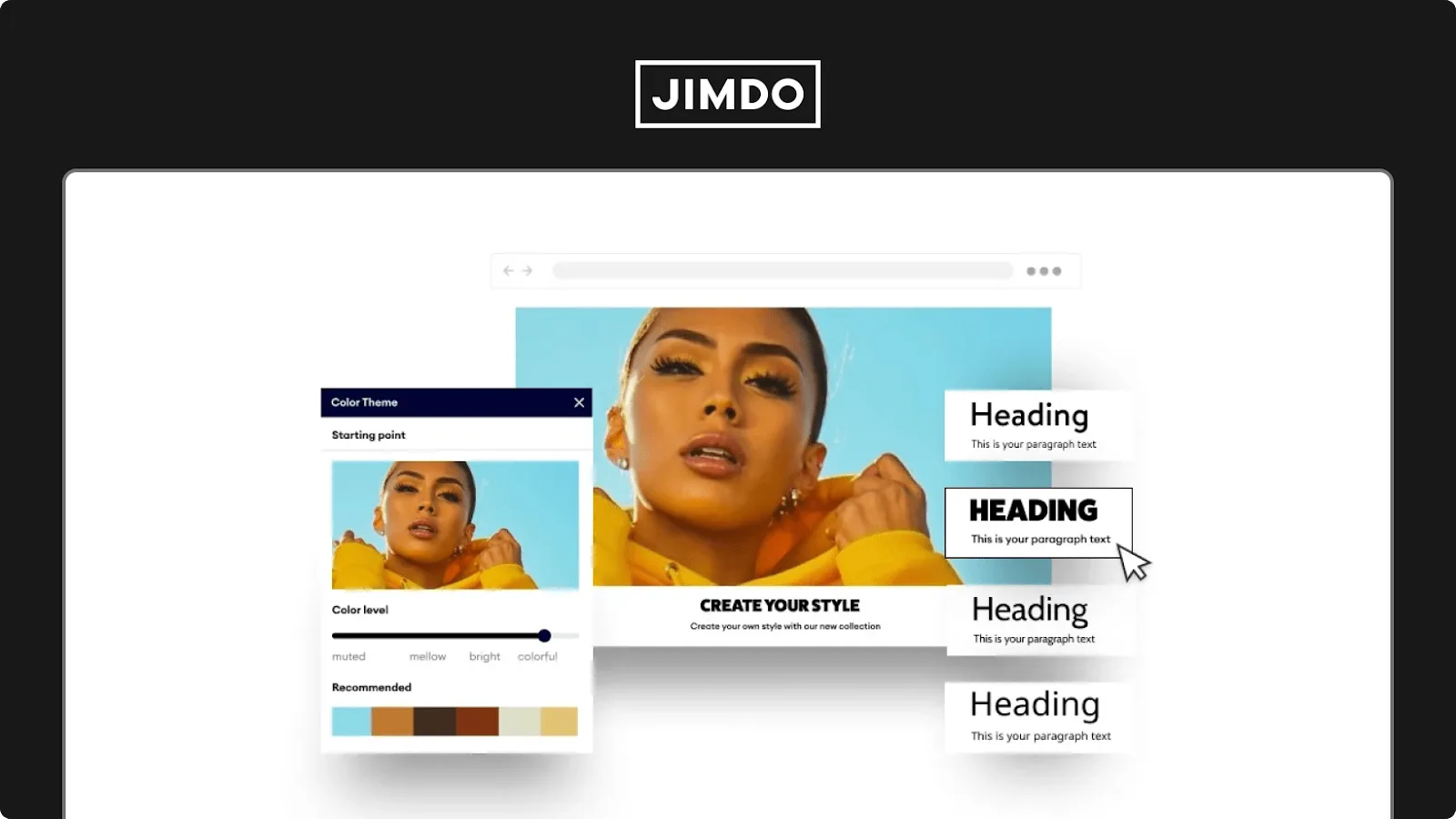
Like Wix, Jimdo was among the pioneers of AI website builders. In 2017, it introduced its AI editor, Jimdo Dolphin. Though they were a little late to the AI game when compared to Wix, they have caught up very well. The tool can set up a website in less than 3 minutes by using answers provided to simple questions about the type of site needed, the business name (to pull in your Google listing), and if there is a need to connect Facebook and Instagram. In a matter of minutes, the application processes the data and makes a site complete with images, business names, contact details, and text about your brand. The best part is that all the editing of content takes place in a line format, rather than a separate window, making the process super easy.
Lots of customization – Users can change the layout of different sections by simply copying and pasting content blocks. There is also the option to add contact forms, booking data, music players, images, and click buttons.
- Design templates – Aside from a host of designs and themes, there is an option to edit color and font, and even add animations to the website. All websites are mobile-responsive.
- Smart suggestions – The Jimdo AI offers suggestions for site colors, high-quality images, and brand descriptions, based on your social media profile information.
Jimdo is an amazingly easy-to-use AI builder that lets you create simple business websites, portfolios, and platforms that take bookings, at a price point lower than Wix. Unfortunately, its SEO options are very limited: users can set a homepage title and a single title for all other pages.
- Pricing – From $11 to $45 with limitations on subpages
- Free Plan – available
- Best for – Detailed and customizable setup
5. Shopify AI
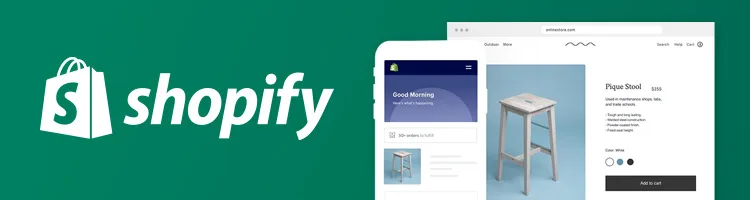
With Shopify AI, users cannot build a website from scratch (yet), but they do give users a range of powerful AI-powered customer support. You can think of it as a productivity booster or as a creative partner who helps in brainstorming and automating tasks. Let us see some of the likely features Shopify AI provides:
Shopify Magic – Similar to ChatGPT, this is a machine learning model that provides generative texts for web pages, including blog posts, product descriptions, summary snippets for highly rated applications, and a chatbot that auto answers customers' FAQs, as well as prompts them to leave their email for follow up. The benefit is that, unlike ChatGPT, it is more tailored to the e-commerce business.
- Shopify Sidekick – A highly knowledgeable assistant who assists in streamlining tasks, ranging from adjusting pieces to programming sales.
- Multilingual support – As you would have guessed, this generates and translates content in multiple languages, including English, Spanish, and Chinese, to help reach a diverse audience.
- AI image editor – It aids in improving product images used in promotions and provides mobile accessibility for on-the-go updates.
Shopify AI does very well when it comes to automating many marketing and administrative tasks, but the creative aspects still need a lot of improvement. It also lacks a visually modern interface as compared to its competitors.
- Pricing – The basic plan starts from €24 per month for Shopify accounts.
- Free Plan – not available
- Best for – Already existing Shopify customers. AI is not offered separately, it is available with existing Shopify plans only.
6. Hostinger
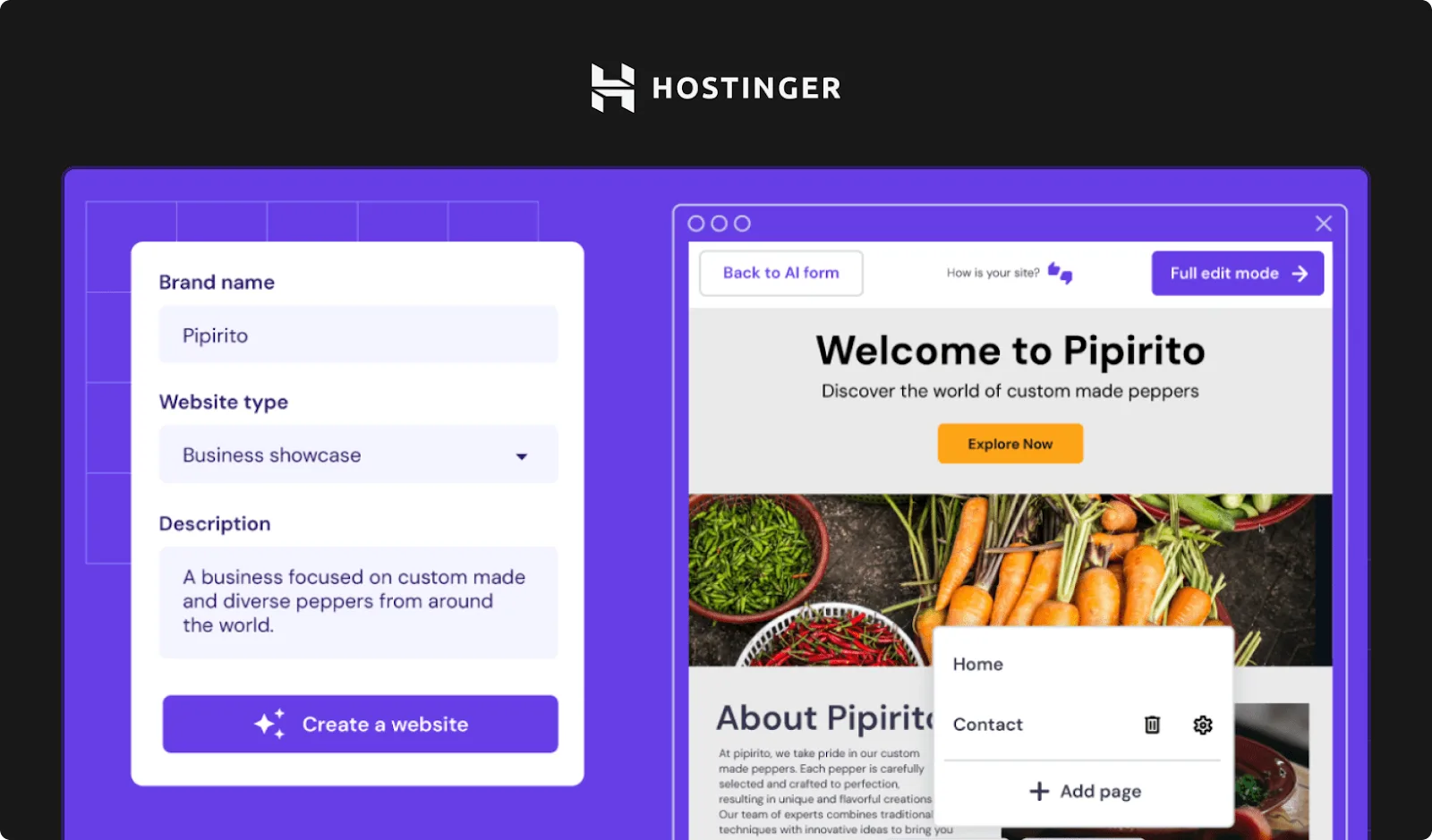
Hostinger is one of the more affordable website creators providing an impressive suite of AI tools. The system works similarly to all the other applications where you submit a prompt describing your website, along with the brand name and type of platform, like an e-commerce store. Using this information, the tool can provide you with a personalized site with a few AI-generated images that are easy to swap and edit as per your requirements. Compared to other applications, such as SpreadSimple and Wix, Hostinger’s web pages are not up to the mark, but they are a great starting point, especially in terms of pricing.
In terms of AI-powered assistance, they offer quite a few features:
- It lets you import an existing web page or platform from somewhere else and use it as a reference point. This is great as existing users do not need to start with a blank slate each time.
- Using the AI word generator, users can get keyword-rich content for texts and blog posts. Unfortunately, there is a daily limit on using this tool by Hostinger.
- They also provide an image and logo creator that provides not only images and new logos but also product titles, subtitles, and labels.
- A wonderful highlight of Hostinger is the heatmap that lets clients know where their visitors are often clicking. This helps optimize the website’s design and navigation while also improving the overall customer experience.
Overall, the software feels more like a simple website builder that also offers a few AI-powered shortcuts and assistance. But the USP of the product is its price point which is ideal for individual entrepreneurs.
- Pricing – From $1.95 to $7.59 per month, if paid annually
- Free Plan – No free trial or plan
- Best for – beginners with budget constraints
7. Squarespace
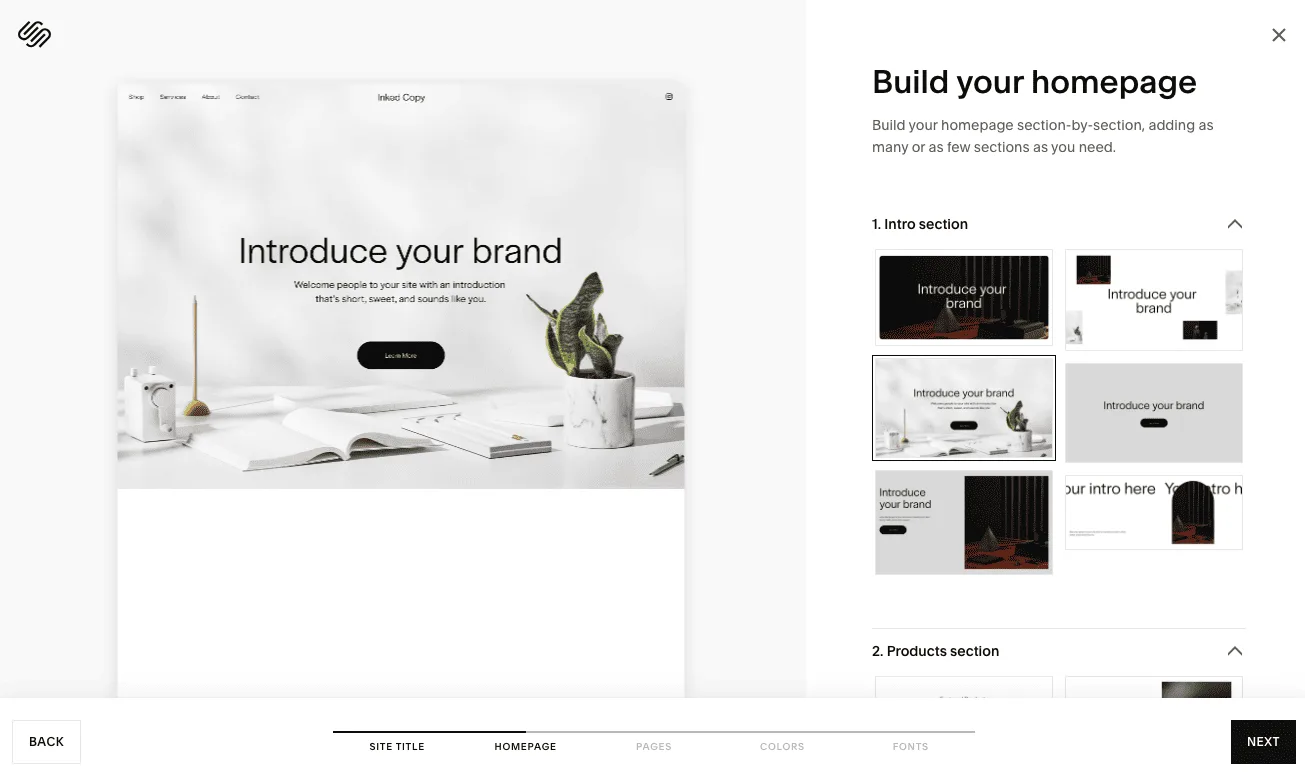
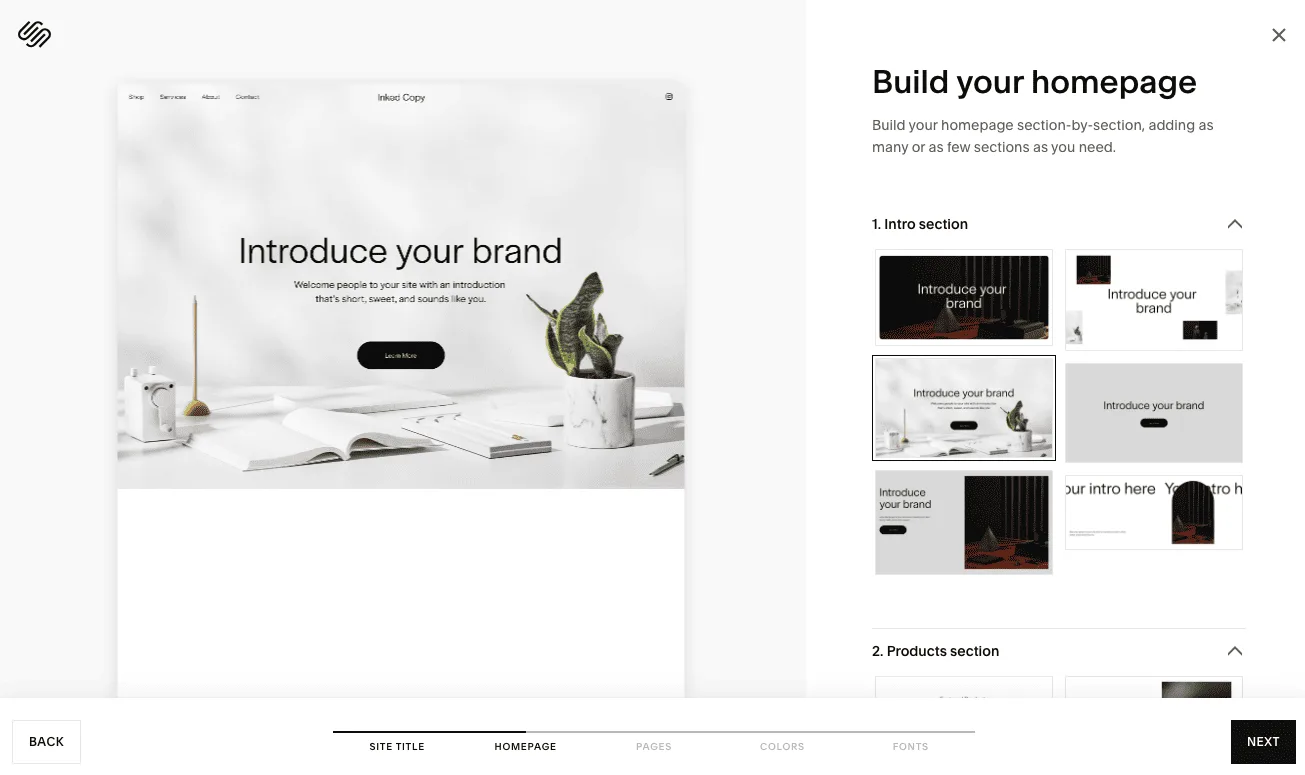
Squarespace is the only application that has carved a niche market by being the go-to platform for seasoned designers and creatives. It provides many variations of sleek and minimalistic design elements and eye-catching templates. But don’t mistake it for just a haven for artistic people. Squarespace boasts a great set of e-commerce capabilities along with robust blogging functions, which are great for building a stylish website. Unlike other tools in the market, instead of answering questions, users craft a home page by selecting from various layouts and then choosing from a range of color palettes and fonts. Later, they can add a few additional pages as per their business requirements.
Blueprint AI – This is the newly revamped AI offer of Squarespace which not only generates a web page for the user but also takes into consideration their preferences. It provides personality-based color schemes, lots of styling options, and recommends additional site pages in its five-step process.
- AI text generator – Similar to other applications from above, there is a text generator tool that helps create content for your website. It includes email marketing campaigns, product descriptions, text boxes, etc. The system also helps pick a writing style, such as professional, playful, neutral, informative, friendly, and quirky, then provides a preview of that option.
It is the most simple website builder when it comes to operations, and its range of growing AI capabilities only helps solidify its position in the market.
- Pricing – Range from $16 to $52 per month paid annually
- Free Plan – free trial available
- Best for – great choice for artistic designers and first-time entrepreneurs
8. GoDaddy
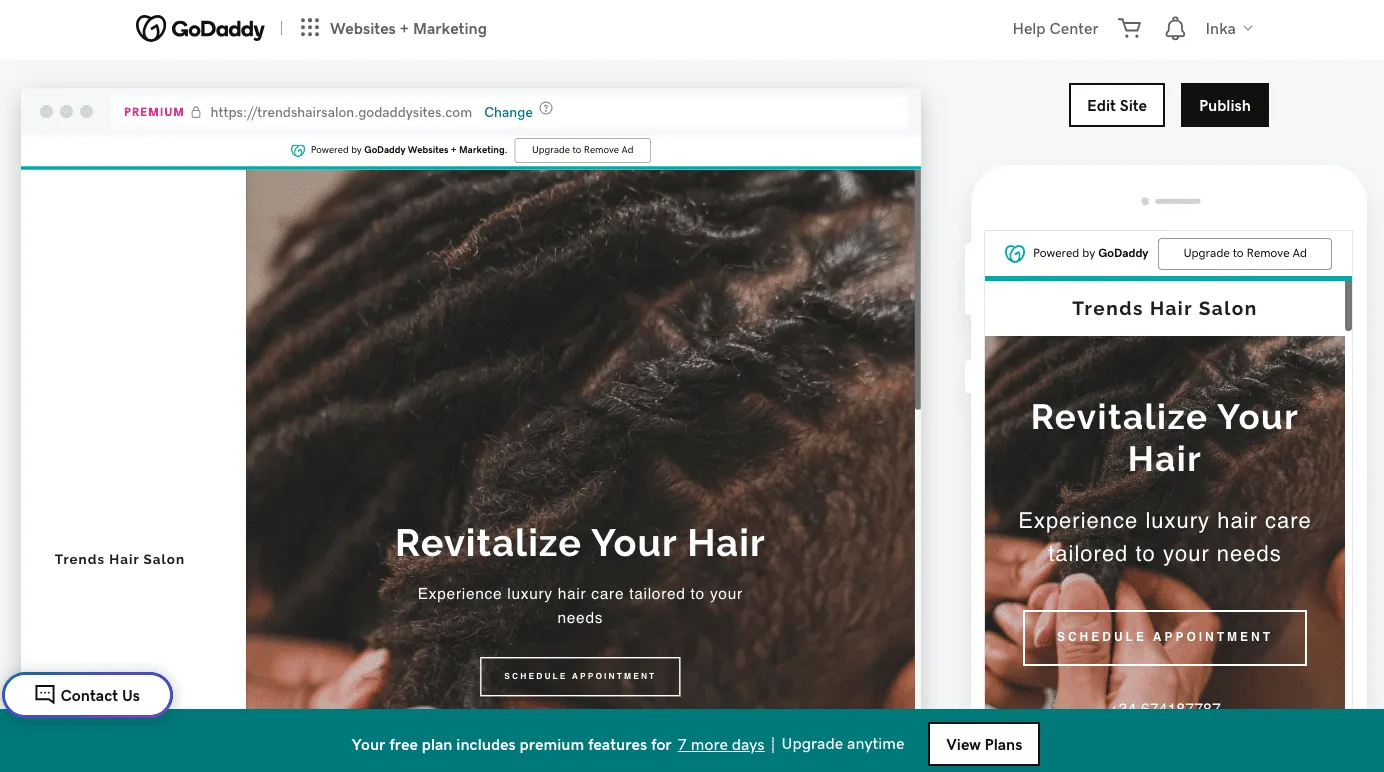
Originally, GoDaddy has been a great platform for people to buy domain names and build websites. Every few years, the company overhauls its systems to provide patrons with newer features and better facilities. It is a wonderful application that integrates marketing functions, such as social media management, digital advertisements, email marketing, and calendar alignment. Recently, they launched their AI-powered website creator tool that helps users make a business portal in a matter of a few minutes. The software focuses on speed and simplicity along with a host of customization options.
- GoDaddy Airo – Launched in February 2024, this software was designed to help small business owners with growing their presence online. For instance, it helps you generate a social media calendar schedule and also set up a branded email account to reach audiences more efficiently.
- AI domain name generator – As the name suggests, this assists in finding a suitable custom domain name for customers from the vast library of GoDaddy’s portal.
- GoDaddy Studio – The studio feature offers advertisements in the form of videos and images that can be posted on social media platforms to market your business. It can also be used to create logos that improve visibility online and aid in brand recognition.
- AI prompt library – The AI tool offers a prompt library that helps you write better requests for a variety of company needs, such as content marketing strategy, optimizing SEO capabilities, and employee scheduling.
GoDaddy’s AI is ideal for beginners who want an online presence quickly and smoothly. The generated result may not be ultra impressive and appealing as other builders like SpreadSimple and Wix, but they do manage to provide a foundation for the online business.
- Pricing – Ranges from $9.99 to $22.99 per month (billed annually)
- Free Plan – available for testing
- Best for – Simple processes and easy to use
9. IONOS

Just like Hostinger and GoDaddy, IONOS is a two-in-one application that combines hosting services and website building. It is a solid pick for new business owners who want an online presence simply and quickly. The tools this software provides are amazing when it comes to SEO capabilities and content writing. The overall website created is hassle-free and runs smoothly without much work. That being said, let us look at some of the features it offers the clients:
AI website creator – Just provide basic business information like brand name, industry, products, etc, and the software will make a website for you in seconds with the template provided. There is an option to tweak and make edits as per your requirements and add more structure to different sections.
- AI text improver – This feature allows users to not only generate content but also improve the tone of voice to suit their brand. It is unique to only IONOS and makes sure that the tone of the text is consistent all across the website. This is extremely useful when targeting specific audiences or industries.
- AI SEO – Similar to other bigwigs such as WIx, Spreadsimple, and GoDaddy, this tool can suggest metadata and tips to make your platform SEO-friendly.
- AI image generator – With just the help of a prompt, users can create high-quality images to post on their website.
- AI color palette generator – Using AI, you can create a harmonious color palette that aligns with your brand vision and industry by just specifying your desired impressions.
There is a reason that IONOS is on the bottom of our list; its AI-powered tools are not as good as the above. Despite this, we found that the AI building process offered is incredibly efficient and helps new users get online fast without putting in a ton of effort.
- Pricing – From $1.00 to $30.00 per month.(the $1 plan is only available for the first year)
- Free Plan – No free trial or plan
- Best for – simple SEO and marketing support
How AI website builders work
AI website builders leverage machine learning algorithms to streamline and automate the process of website creation. You might then ask what machine learning is? It is the process where the system is trained to improve its performance consistently by combing through large amounts of data. This data might include information, such as the types of businesses, industry-specific requirements, user preferences in layout, etc. Using the above information, the AI tool can then create websites that closely match the client's requirements.
The website-building process, in general, remains the same with drag-and-drop facilities, pre-designed templates, content suggestions, etc. However, the addition of AI-powered tools just helps streamline this process and change it from manual work to automated execution. With time, the AI becomes more efficient and accurate in its predictions and understanding of the user’s needs.
As you are aware, this advent was brought in with the creation of ChatGPT which pushed machine learning to move faster and get better. Even though we are a little far away from complete automation of the website builder softwares, the incorporation of machine learning and AI by so many companies tells us the software is on an upward path and soon will be able to assess user needs effectively and extremely efficiently.
Benefits and Limitations
AI is gaining a lot of momentum by being the most efficient and least time-consuming tool out there for individuals. Thanks to this new software, every person can now launch a website quickly without having any web design ideas or technical knowledge. But like everything, it does have both benefits and limitations. Let us dive into them:
Benefits
1. Enhanced efficiency in the creation process
The process of building a website happens to have many repetitive tasks, such as formatting buttons, font selection, setting up sections, content writing, etc. Since AI can easily handle these functions faster than manual work, the users’ time can be better utilized for core functions like revenue generation, launch planning, etc.
2. Creative control on the website
Since AI provides personalized templates and design options pertaining to your industry and business needs directly, the website looks unique and professional. There is also a lot of creative control as users can tweak elements to create a brand identity by changing colors, contents, and layouts to match their requirements.
3. Overall productivity boost
AI removes the need to learn coding or possess technical skills in website building. Hence, companies can focus their attention on other aspects of their work and improve overall quality and efficiency. Most AI builders are user-friendly in design so that they are easily accessible to everyone. They can even optimize your website for SEO which helps improve its productivity and revenue generation capabilities in the long run.
4. It improves constantly
AI is a self-learning mechanism that is always moving towards improvement. They provide great tools to users and enhance their ability to build profitable websites. For instance, generally in website building, a person has to research to make their design layout unique yet in trend with its specific industry. This process is time-consuming. But AI negates this factor and provides a personalized web design that makes the website unique yet about their business requirements.
Limitations
1. Lack of customization
Though AI offers a lot of convenience and time-saving, they do have limitations when it comes to customization. As the saying goes, if everyone looks the same then what makes you stand out in the crowd? Since every person is slowly moving to AI builders, users who are looking for complex design elements and unique looks may find these tools restrictive. The website may seem generic to people due to the predefined layouts and templates provided.
2. Dependency on AI
Since AI-powered tools rely on machine learning algorithms to perform tasks like content generation, design templates, and optimization, they may not always take into consideration the specific preferences of a brand. Owners who prioritize a human touch or personalized service may find AI-generated content lacking in creative nuances that a human designer can easily provide.
Tips for choosing the best AI website builder
Since you have gotten an overview of the top AI website builders in the market today, it is time to understand which software to use for your business needs. While most of the AI-powered tools mentioned are quite impressive in their functioning and help save a lot of time, business owners need to make sure the application they are selecting is the right one for them. For instance, an AI with product descriptions will only be important if you are building an online store. So to get a better idea of which website creator to choose, try and answer the following questions:
- Are the AI features I want available in this software?
- Does the website builder have all the tools I need, such as email marketing, SEO, and e-commerce capabilities?
- Does the price of the software fit into my financial budget?
- Does the software team offer 24/7 customer support if I need to resolve an issue?
Selecting the right AI-powered website builder depends on each business’s specific needs and goals.
1. Start with analyzing your own web design experience and the expertise you possess. If you are a new startup, then find a tool that is user-friendly and uses a simple drag-and-drop interface, like SpreadSimple or Jimdo. Such platforms are designed for people with no coding skills and are made to be accessible.
2. Next, move on to thinking about what type of website you are creating. If your requirements are advanced design features and interactive elements, then maybe software like Framer or Squarespace may be a good choice. But if the requirement is a straightforward functional web page with good SEO, then SpreadSimple or Hostinger may be more up your wheelhouse.
3. An important factor to consider is the design options provided by the application. Ensure the builder tool offers a variety of design templates and also gives the ability to tweak them to match your brand. Customization is key to ensuring a website looks unique and professional.
4. Budget is the core of any business decision. Many AI builders offer free plans which can be wonderful for small business owners and startups. But make sure the features included in these plans meet your needs. Chances are, in the short term it might be a good decision which will end up costing you more in the future.
5. Finally, look at the customer support and resources provided by the application’s team. Prefer choosing a platform that provides tutorials, FAQs, and 24/7 customer service. A quick way to do this is to read existing customer reviews and feedback to know how the website builder has been functioning.
Taking these factors into consideration might help you make an informed decision when selecting an AI website builder.
Conclusion
Though it might seem like the AI revolution will completely change the website building environment, it does have a long way to go before it can be fully automated and incorporated. For now, it is a wonderful aiding tool that drastically cuts down the amount of work needed to create an online website, especially for beginners and startups. Based on our research, we found that SpreadSimple and Wix are highly recommended AI website builders we would suggest to our readers who are starting their online business journey. Take into consideration all your business requirements and make a wise choice when selecting the tool for your company.