If you have a passion for fashion and want to start an online clothing business, you have come to the right place. With e-commerce thriving and easy-to-use tools at your fingertips, it is a wonderful small business idea that lets people capture a little bit of the estimated $1.6 trillion consumers spend on clothes yearly.
In 2023, retail revenues from apparel and accessories in the USA reached $182.5 billion, and by 2025 Statista projects this value to be around $296.7 billion. So there is no better time to launch a clothing line than the present.
The fashion industry has skyrocketed due to many growth channels, increased online presence with mobiles, no-code website builders, and other technological innovations. However, creating a clothing brand from scratch does not happen overnight. It requires a lot of work, coupled with knowledge and expertise. To help fellow entrepreneurs, our team has written this guide that will walk you through the basis of starting an online clothing business with minimal investment and effort.
Understanding the online clothing business
Traditional brick-and-mortar shops are still very much present in the market and have a strong foothold in the industry. But in recent years thanks to online advancements online apparel sales contribute nearly 47% of all dealing in the United States. Some of the biggest advantages of the online clothing business are:
- Easier entry – Building an online business takes just a matter of days and little investment while creating a storefront can take a few months to build everything from scratch. The amount of finances needed for an offline shop is also much higher in comparison.
- Lower operations cost – Opening a brick-and-mortar store can cost between $50,000 to $150,000, while most online apparel stores require much less investment, as shown below.
- Convenience for shoppers – Firstly the shopping process online is extremely convenient for customers as compared to traveling to a store. The second benefit is that e-commerce shops have a wider consumer reach than traditional places.
- Omnichannel marketing – Marketing the products is much easier to do with so many social media channels and they also help to create a seamless customer experience.
One of the big parts of starting an online retail company involves choosing a business model. There are four main choices to select from – Print-on-demand, custom cut-and-sew, private-label clothing, and dropshipping. Let us understand this better ahead and also the steps to follow when starting an e-commerce apparel shop.
Steps to Start a Clothing Business
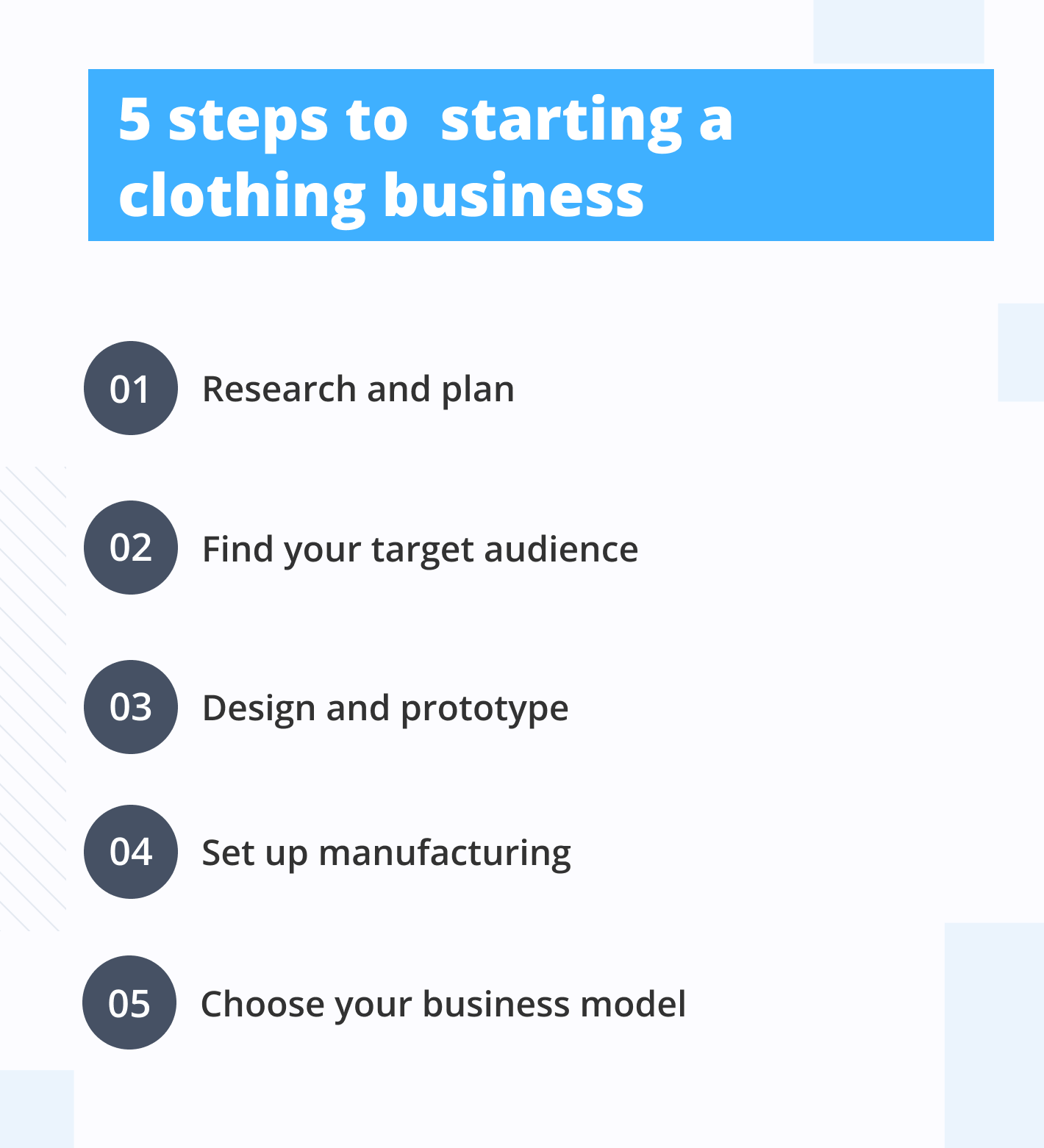
Before you start producing clothes, there are five preparatory steps you need to take to make sure your business kicks off.
Step 1: Developing a business plan
No matter what company you are starting it is always a good idea to develop a business plan that helps gather your thoughts and pushes the enterprise toward success. Even for creating a small online clothing startup, make sure to create a written document outlining all the goals, targets, and action plans that need to be executed. This step helps to communicate the vision with your potential inventors, partners, and future target audience. Think of it as a roadmap for your fashion business’ growth and development. Some of the key components that should be included in the business plan are:
- Executive summary – As mentioned, start by writing a brief overview of the proposed business, including things like vision, mission, and primary goals.
- Market analysis – Make sure to have a section with detailed research on the target audience and the niche market you are hoping to enter. The information should include preferences, demographics, consumer purchasing habits, and competitor analysis.
- Unique selling proposition(USP) – Find the factor that makes your goods or apparel different from the competition. It could be sustainable materials, aesthetics, design, durability, etc. This unique element is what will help you to market and sell your product better.
- Production and distribution – Outline information in your plan about the clothing manufacturing process which should have sourcing, production, and logical strategies in it. Also make sure to include distribution and delivery channels, as well as how to reach the target audience.
- Financial projections – Financial planning is the backbone of any new business plan. It includes expenses, revenue projections, and profitability information, which helps companies understand their apparel store’s future viability and potential.
Step 2: Deciding on the target audience
Once the plan of action has been written down, it is time to do some market research and figure out your target audience. This step gives entrepreneurs lots of insights into their future consumers’ needs, preferences, and purchasing habits. There is also competitor analysis done here that helps to identify opportunities and industry gaps that other brands have missed out on. Doing thorough research before designing your new clothing line will help you to make informed decisions and increase your chances of success. This step requires the following:
- Finding your target audience – This step helps to identify who you want to reach with your online clothing business. For instance, knowing the potential customer's age, gender, location, interests, buying habits, income level, etc.
- Conduct surveys and interviews - Next is reaching out to marketplaces and forums to contact potential customers and ask them about their purchasing habits and preferences. This can be done in person through interviews, by using focus groups, online surveys, and by connecting with people on social media by using questionnaires.
- Analyze market trends – Thanks to applications like Google Trends, entrepreneurs can not only research the present fashion developments but also exploit them to their advantage. This will help to identify gaps in the market and align the clothing designs with consumer personalities.
- Monitor your competitors – Last but not least, keep a close eye on what your competitors are manufacturing and doing. Detailed information about their pricing, marketing, distribution, and marketing strategies, will help to differentiate your apparel and make them stand out. It will also assist in giving you an edge and avoiding mistakes made by them.
Step 3: Designing and prototyping products
Now let's get to the main event of selecting a clothing niche for the business. It is a segment of the market that is defined by its own unique identity, preferences, and needs. For example, vintage clothing, sportswear, children’s garments, plus size, etc.
We know it might seem counterintuitive to just focus on a small group of people, as the goal of any enterprise is maximum revenue generation. But when it comes to the fashion industry, every person has a different outlook, taste, and interest. It is impossible to create a product that has a universal appeal. The issue here lies that if you try to please everyone, there is a possibility you might end up pleasing no one. So do the homework and pick a niche that works best for the business and has good growth opportunities for the future.
Now we come to a defining step where the actual prototype of the product shall be made. Unique designs can help the company stand out from the crowded fashion market. Here are some guidelines to follow when designing the product:
- Create your brand’s identity – Choose a name for the website that highlights your brand’s characteristics, such as the mission, goals, and value. This stage becomes the foundation of the enterprise. Do not forget to check for its availability and trademark it for legal purposes.
- Sketch your ideas – Let us get down to work and make designs that you believe will sell in the niche market. Take a pencil and paper and sketch designs, or work on illustrations with online graphic design. In this process, there will be a lot of experimentation, visualization of concepts, and adjustments. Once you have a few prototypes, get feedback from near and dear ones whenever possible or float some of them on social media to receive valuable insights from audiences.
- Create mockups – The best way to know if a design works, is to create a mockup of it by using applications like Printify Product Creator or PlaceIt. This helps to visualize your ideas for clothes in real life. If the prototype is good, then save it for later use for manufacturing.
- Work with a manufacturer – Now that you have a fair idea of what the product looks like, the last step requires collaborating with a manufacturer or designer to bring the design to life. This way the physical prototypes will be created and can be checked for quality and durability. One good way to find creators is by using platforms like Fiverr to hire a freelance fashion designer or manufacturer.
Step 4: Setting up manufacturing.
Any online clothing band needs a collaboration with a manufacturer or production unit for sourcing the apparel. This stage will require a lot of research and comparison between different companies, their prices, and delivery capabilities to see if they are the best fit for your fashion business. Here are a few steps to follow when setting up your manufacturing distributor:
- Understand your production needs – Identify your enterprise’s production requirements, including the type of apparel (eg, shirts, jeans, sportswear, nightdress, etc), the quantities you require, and the desired timeline.
- Research the market – Look for potential manufacturers on Printify, a network that has over 80+ print producers in the United States, United Kingdom, Europe, Australia, Canada, and China. This allows you to sell worldwide. There are also online directories and publications to get designer referrals on social media platforms.
- Order product samples – Finally, order a few samples from different designers to compare their product quality.
The last step is extremely crucial as the sample will be directly related to your brand identity. Test the manufactured prototype for fit, durability, and the quality of materials used. Look for any visible defects, such as loose threads, misaligned seams, or imperfections in the fabric and printing.
The next step is to evaluate the materials that meet your standard, which means that buttons, zippers, fabric, and threads are all of top quality. Also, wash the samples a few times to see how they hold over time. Ask your friends and family to test the clothes for comfort and fit. This way you will know if the apparel will meet your customer’s expectations or not.
Step 5: Choosing business models
There are many different business models to choose from when starting an online clothing enterprise. Each of these types has its own set of benefits and drawbacks, and the right one depends on your brand’s goals, resources, and target audience. Let us explore a few of these:
The print-on-demand(POD) model
In this type, the business sells custom clothing designs through POD platforms by listing them on their website. Here the product gets manufactured only after a customer puts in an order. After that, the production partner makes the design and ships the apparel directly to the consumer. As an owner, you only have to provide many creative ideas for your online store and market them to potential users.
- Pros – low startup cost, easy setup, and customizable product.
- Cons – limited control over quality, high dependence on third-party platforms, and recurring design creation.
Dropshipping business
Dropshipping is a hand-off option where you partner with a manufacturer or wholesaler who handles inventory and also order fulfillment. When a customer buys apparel on your website, the information is forwarded to the supplier, like Aliexpress or Amazon, who then ships the goods directly to the consumer.
- Pros – No inventory cost, easy setup and management, and wide range of product availability.
- Cons – smaller profit margin, extremely limited control over service or order fulfillment, and high dependence on suppliers.
Private-label manufacturing
This model is great for entrepreneurs who prefer to have control over their products. In private-label manufacturing, an enterprise collaborates with a big apparel producer and creates a custom clothing line for its target audience. Here the product is bought in bulk and sold on the online store with your brand name on it. This offers higher profit margins and greater control over quality.
- Pros – high profit margin, branding opportunities, and control over quality.
- Cons – strong manufacturing relationship needed and large financial investment.
Selling wholesale
This type of model works ecstasy like a brick-and-mortar store but in an online version. As a company, you will purchase lots of different apparel in bulk at wholesale prices and then sell them at a premium on your website. The inventory is managed by you as well as the order fulfillment There is a much higher profit margin in this model, but also substantial investment.
- Pros – inventory control, access to unique products, and high profits.
- Cons – no customization options, risk of unsold stock, and huge upfront investment in inventory
Making your clothing
The last model is self-explanatory. In this the entrepreneur designs and manufactures clothing items in-house for selling online. It requires significant financial investment and time to create but offers maximum control over the entire business process. If you want to offer unique and high-quality products that reflect your personal style and brand identity, then this is the best format for you.
- Pros – unique product offerings, personalized branding, and complete control.
- Cons – high startup cost and longer production time.
Financial Planning
The core of any business happens to be financial planning since the goal of an enterprise is profitability. When starting a new online clothing company, it is important to determine the startup cost, inventory management, and pricing of the product.
Calculating startup costs
As we mentioned above there are many different models to choose from when entering the online fashion industry. Each of these comes with their price points. While some of these require thousands of dollars as upfront costs, others can be started with minimal financial investments. Some of the expenses that need to be considered when starting a clothing line business are platform subscription fees, hosting expenses, inventory management, employee payrolls, utility costs, logistics supply, and marketing budgets.
The overall startup cost of building an online e-commerce store largely depends on whether you make the website from scratch with an open-source solution or go to a no-code website builder like SpreadSimple and let them do all the backend work.
While open source would be free to download and use, it does have many hidden costs, such as hosting, development, security, customizations, integrations, compliance, and maintenance. For new businesses, these expenses can cause a major dent in their planned budgets.
However, if an e-commerce platform is used then the website can be created with just a monthly investment of $14 per month with SpreadSimple. The best part is that they take care of all the functionalities, updates, security, hosting, compliance, and maintenance needs.
Managing inventory
The next thing that affects finance the most in an apparel enterprise is inventory management. As already written, many different types of business models can be used by an entrepreneur looking to enter the fashion industry. Each of these formats affects the inventory costs differently since in some of the models like POD and dropshipping, there is nearly zero inventory storage expense. However, when it comes to businesses such as private label manufacturing and selling wholesale, there is a requirement for a warehouse unit or space to store the inventory before selling. There is also the added cost of order fulfillment which requires collaborating and paying a distributor or logistics company.
Since you are starting as a new venture, we advise new business owners to try and stick to dropshipping or POD models as they are great for testing the market without using tons of money and also offer huge future growth opportunities.
Understanding pricing strategies
The last and most important aspect of an enterprise's financial planning is pricing its products, especially in the fashion industry. There needs to be a perfect balance between offering attractive prices to consumers and generating a profit. Normally the thumb rule in the online clothing business is adding a 40% margin on top of your production expenses for good financial gains. Here are a few things that can help you in determining the right monetary value for the apparel.
- Research your market – In the business planning stage, we researched the niche market we were entering. This helps to determine the demand for your product, the competitor’s offer, and the overall price range of the clothing category.
- Consider the costs – Make a complete calculation of how much it costs to manufacture the apparel and sell the clothes, including factors like labor, materials, delivery, and overhead expenses. This will assist in determining the minimum production price of the product and what margins are needed to generate a profit.
- Test different prices – When starting a new venture, it is a good idea to experiment with different price points to see how they affect sales and customer feedback. Using online tools like Google Analytics and Optimizely, to conduct A/B testing, we can compare the performances of different values.
- Adjust your prices – Always change the pricing of the goods over time based on their performance. This means monitoring the changing demands, operational costs, inflation, and competition.
- Offer free shipping – In the online apparel industry, one of the most effective marketing techniques is to offer free shipping. Always add the costs of delivery into the product pricing. For instance, a consumer is more likely to pay $75 for a custom jacket than $65 for the apparel and $10 for shipping.
The final crucial element in financial planning is the checkout process. Research has shown that around 32% of online shoppers would abandon a cart in the United States as the checkout process took too long or was complicated to operate. So make sure that the final transaction web page is fast, efficient, and easy to access. It should accept auto-filled details when possible, and also cater to a variety of payment processors, such as gift certificates, credit and debit cards, PayPal, and Stripe. For repeat customers offer a one-click checkout option.
Setting Up Sales Channels
To conduct business online requires setting up a sales channel to reach out to your customers and sell the product. This is a very crucial step in the clothing enterprise as there are many different options to choose from such as online marketplaces, e-commerce platforms, and physical stores with websites.
Creating an e-commerce store with SpreadSimple
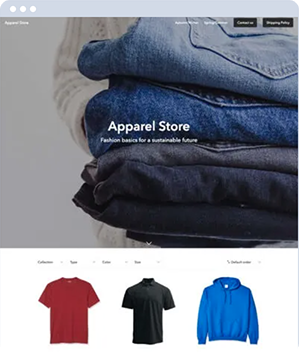
An e-commerce platform is a single-seller website where the online business owner can sell their clothes. For any online store, the website becomes the face of the brand. Creating and maintaining an e-commerce platform today has become easier than ever thanks to many no-code website builders like SpreadSimple in the market. It allows users to create a high-quality, visually appealing clothing business website in a matter of just a few minutes, even if they do not possess any technical skills. Launching an e-commerce platform helps boost your brand’s visibility and offers a professional space to engage with your target audiences through the Internet.
SpreadSimple is a great choice for new enterprises who want to enter the online domain. Since you are starting and do not want to spend a lot of time and energy figuring out complex coding, we recommend using a modern no-code website developer and saving valuable time, effort, and most importantly money. To get started just follow the three easy steps mentioned below.
1. Choose a Theme or Template
The first thing you want to do is choose a theme or design for your website that matches your logo and brand's color scheme. SpreadSimple offers in-built templates that any business owner can use and customize as per their requirements. Each template comes with a Google Spreadsheet which you can extend and fill out with your data.
2. Add Products and Services Information
Now that you have your basic template and design, the next step should be to add your product information to the Google spreadsheet. Make sure to incorporate major keywords, as well as graphical content like images and videos into the descriptions of your apparel as they can give your portal an SEO boost which in turn will help you rank higher in SERPs.
3. Create Checkout Policies
Think of checkout policies as the rules of your clothing business that customers must be aware of. They are like the Terms & Conditions which tell the users about your policies for cancellations, promotions, deals, exchanges, etc. Make sure to keep this information clear and concise for your potential consumers.
Besides no-code website builders, there are also applications such as Shopify and Wix that help users create their online stores and sell products directly to a target audience. They do offer a wide range of templates, tools, and features to assist in managing and growing an apparel business, but they require higher investment, time, and some level of technical experience.
Using online marketplaces
The next best thing an entrepreneur can opt for is selling in an online marketplace. It is a website where products from multiple vendors are compiled into one well-organized catalog. A good example of these would be platforms like eBay, Amazon, Alibaba, and Etsy. These applications are a great way for startups to boost their online sales, clear inventory, and increase brand exposure, especially if the business is offering a unique product. On top of that online marketplaces possess brand loyalty and happen to have a large host of subscribers with them.
Some of the benefits that online marketplaces offer are:
- Two-thirds of internet shoppers prefer buying items from well-known marketplaces such as Amazon and Alibaba.
- Many of these platforms give the brands control over their front-end presentation, so it is possible to create truly amazing product experiences.
- The user interface offered by marketplaces is efficient, easy to use, and requires zero technical skills to manage and operate.
- These websites cater to a wide and diverse audience of potential customers.
They do have a few drawbacks also:
- More than 90% of all global marketplace sales take place through only the top-ranking platforms.
- It is hard to make your apparel stand out as there is massive competition taking place in the application itself, especially in the fashion industry due to the high number of diverse audiences.
- There is very little customization possible on these platforms and the charges to list your clothing goods are also steep.
Establishing a physical presence
Though brick-and-mortar stores restrict the presence of a brand drastically to a city or region, they still are a great way to sell clothing goods to consumers. The ideal business model would be to have a storefront in your hometown and also sell apparel through a website to a global audience. They assist in establishing trust with the target audience as people, in general, are still skeptical of buying products online, as they fear scams and quality issues. With a physical presence, potential customers feel at ease while purchasing apparel through your website, and some also prefer the option to come into the shop and try the clothing before buying.
Ultimately the right sales channels depend on the clothing line being offered by the business and what are its budgets, target audience, and future goals. Take some time to research and compare different channels to find the one that best fits your needs.
Marketing your clothing line
Now that your online clothing store is up and running, it is time to generate traffic for your website and find customers. There are many different ways to do this, let us understand a few simple methods to achieve it:
- Develop a marketing plan – Make a marketing strategy that outlines the company’s goals, and target audiences, as well as promotes the clothing brand.
- Build a brand identity – Create a brand identity that is unique and consistent and also reflects the essence of your clothing line to help it stand out from the competition. These include elements like logos, images, color palettes, website content, tone of voice, and visual aesthetics.
- Engage with your customers – As we mentioned above, engaging with your audiences through social media platforms, email marketing, and your website is a great way to build relationships and foster a community around the clothing brand. It also helps in gaining valuable insights into the consumers’ preferences, wants, and needs, which in turn drives sales and increases revenue.
- Collaborate with influencers – Today’s online world is run by many influencers. Partnering with them is a great way to increase the following of potential customers. Just make sure that you collaborate with influencers who align with the enterprise’s brand identity and promote your clothing line to the desired target audience.
- Offer promotions and discounts – When starting, a simple way to encourage customers to buy your clothing is by providing great deals to them. For instance, featuring special discounts to first-time consumers and having promotional offers on your website can help boost sales. Adding referral programs and giving incentives can help to grow customer loyalty and find newer buyers.
Let us explore a few of these points below in more detail.
Social media strategies
Social media is not just a tool to connect with your loved ones, but a great way to showcase your fashion brand and products. Engaging with potential customers on platforms such as Instagram, Facebook, and TikTok, can help promote the business faster and generate advertising without spending any money. Responding to comments, answering people’s queries, and sharing relevant visual content will give lots of exposure to your business and help promote the online store on social media. Here are a few practices that can be applied to your marketing strategy when promoting goods online:
- Consistency – Keep your business social media accounts consistent by making sure the posts and tone only relate to the brand identity. This helps customers get used to the voice and schedule of the promotions. So make sure to be predictable.
- Engagement times – Using tools like Google Analytics, find out the times of the day when the business gets the most likes and comments. This way you shall know the optimal time that gets more attention.
- Insight tools – Few of the platforms provide data to help users understand how their profile and posts are performing. Use these to optimize the online content and timing of the posts.
- Profile web page – Last but not least, make sure that the About Me description is accurate and consistent across all social media platforms. Wherever possible, also include a link to the clothing website.
Branding and storytelling
Online growth is best achieved with captivating visuals as they help to get more attention and in turn, drive traffic to the website. They also enhance storytelling and audience engagement. So prioritize taking, creating, or generating eye-catching images, infographics, and stunning video content with editor tools that will leave a lasting impression. This shall increase conversion and also promote the brand.
One great way to interact with consumers is to create blog posts on your website that share informative and engaging content relating to your apparel line or clothing industry. In time this helps to establish your enterprise as a thought leader and attracts potential customers through search engine optimization (SEO).
Finally, also incorporate email marketing into your strategy as it helps to stay in touch with your consumers and promote special offers and new products cost-effectively. Build an email list by encouraging audiences to sign up for newsletters in exchange for discounts or exclusive content. Eventually, you can also automate purchase information and send regular updates with personalized content such as clothing recommendations, upcoming promotional offers, and behind-the-scenes stories.
Collaborating with influencers.
After the pandemic, many influencers and social media gurus have become extremely relevant on the internet. For an online clothing business partnering with bloggers and influencers is a great way to promote their brand and reach their desired target audience. However, an important aspect to consider when collaborating with these persons is to make sure that the content they are generating aligns with your enterprise’s brand values and aesthetics.
Many companies have made the mistake of working with partners who negatively impacted their brand and led to the loss of potential customers. Also, make sure that the influencer or blogger does not engage in controversial or cringe content which can spoil the name of your apparel line and ruin its reputation.
A convenient way to work with social media gurus is to offer them free products to review or pay them in exchange for social media posts, blog features, and promotions. It is a quick and effective way to increase brand awareness and grow revenue.
Leveraging user-generated content.
The most untapped marketing strategy is not leveraging user-generated content. Popular studies have shown that 92% of online shoppers always check what other consumers say about a product before making their purchase decisions. Online clothing reviews from other existing customers are proof that ensure new buyers that the brand is thriving and trustworthy.
There are many different ways to leverage user-generated content.
Firstly, simply the reviewing process by leaving links to products purchased on every relevant web page. Encourage users to also add pictures of the clothing when leaving a testimonial. Send existing consumers free samples, offer discounts, or sales promotions such as limited-time deals, seasonal sales, and holiday promotions, as this would make them sign up for newsletters and emails, as well as engage with the platform. Finally, give referral programs by rewarding customers who bring in new shoppers.
Challenges and tips for success
Any new business venture is bound to have a few challenges along the way. So now that you are ready to launch your online clothing store, here are a few helpful tips to keep the company on track to success.
Simplify the navigation and user interface
If you have clicked on a dropdown menu on a web page and found lots of confusing options, then you are not the only one. Many websites make the mistake of complicating their platform by adding too many confusing choices and menu items. Massive and complex clickables can be downright confusing, scaring customers off before they ever have a chance to make a purchase or even see the products.
The simpler the options and steps, the more engaged a customer feels. When in doubt, always make simple navigation for consumers to breeze through the website and narrow down their focus to relevant points. If the user interface is easy to use and mobile friendly then the users stay on the platform longer and increase their chances of conversion.
Prioritize SEO
Many big conglomerates happily pay lots of money to have their website ranked in the first SERP of platforms like Google. Though newer businesses do not have this kind of budget, they can still influence their ranking organically by prioritizing search engine optimization (SEO) strategies. This helps potential customers find your website through search engine platforms when looking for your product. Organic traffic can be achieved by making the web page's content and product descriptions rich in keywords and phrases that align with your branding and apparel. For a deeper understanding of SEO please refer to 6 Growth Strategies to Boost an E-commerce Startup.
Include engaging web design
Just like in the real world, appearance matters a lot online as well. If the website design is poor, it can cost the business more than it can realize. To ensure that your target audience keeps coming back, make a design that is engaging, attractive, responsive, and mobile-friendly. Add simple items like chatbots, quick reference links, customer testimonials, personalized recommendations, and lots of good-quality visual aesthetics.
Provide popular payment options
As we said before, more than 32% of online shoppers tend to abandon a cart in the United States as the checkout process takes too long or is complicated to operate. Gone are the days when online credit and debit cards were reigning supreme in the world of online payments. Today the market features lots of different payment methods, such as PayPal, stripe, Apple Pay, mobile wallets, etc.
There is also an emerging trend called BNPL – buy now and pay later, which allows customers to choose s financing plan and pay the money in installments instead of giving up the entire cost up-front. So it is crucial that your online clothing business supports many different modes of payments and also caters to a variety of processors, like gift certificates, credit and debit cards, PayPal, and Stripe. For repeat customers offer a one-click checkout option as well.
Targeted Advertising
In the old times when a company wanted to reach their customers, they could simply place advertisements on television and radios and hopefully acquire consumers. But today’s digital world requires a more targeted approach to make sure to reach the audience. If you do not want your marketing dollars to go to the wrong people, then it would help to advertise in the right places.
Figure out where your customers are and understand their preferred mode of entertainment. For example, if you want to reach a younger Gen Z crowd then promote the goods on TikTok and Instagram, but if your clientele are millennials then Facebook and LinkedIn are a better option.
Conclusion
Building any business can be a risky venture but an online clothing store in 2025 is the right place to be. Even though the global economic situation is uncertain and many big brands struggle to maintain relevance, there is an upward trend for small and agile apparel brands that want to capture a niche market. The main aspect is getting started today and being flexible and affordable in your offer. So we hope this article will give you the little push you have been looking for to tap into the fashion industry.