
In the recent decades, the consumer market underwent a major shift and moved from physical store locations to e-commerce platforms. 46% of US consumers have tried a new online store or placed orders with an unknown brand in the last year. Thanks to this trend, there is now a vast and growing opportunity for digital retailers to open their online stores and sell their products. For niche-specific guides, see how to start a grocery delivery business and how to start a bakery.
Whether making unique handmade items or following the dropshipping business model, you will need a great functional website to market the goods and reach the intended target audience. In this article, we intend to help you start an online store in just a few easy steps and make your business dream a reality.
How to start an online store
Starting an online platform can be daunting, but with the help of the right website builder and guidance, you too can become a seasoned entrepreneur and grow a business. So let us explore the steps needed to start a successful e-commerce store.
Identifying your niche and target audience
The first step to any startup, online or offline, is defining the business niche and identifying your target audience. Niche markets are a segment of specialized consumers who are looking to fulfill a specific need. For instance, sneakers would be a niche in the footwear industry. By doing so, business owners can understand who their target audience would be and how to grab their attention.
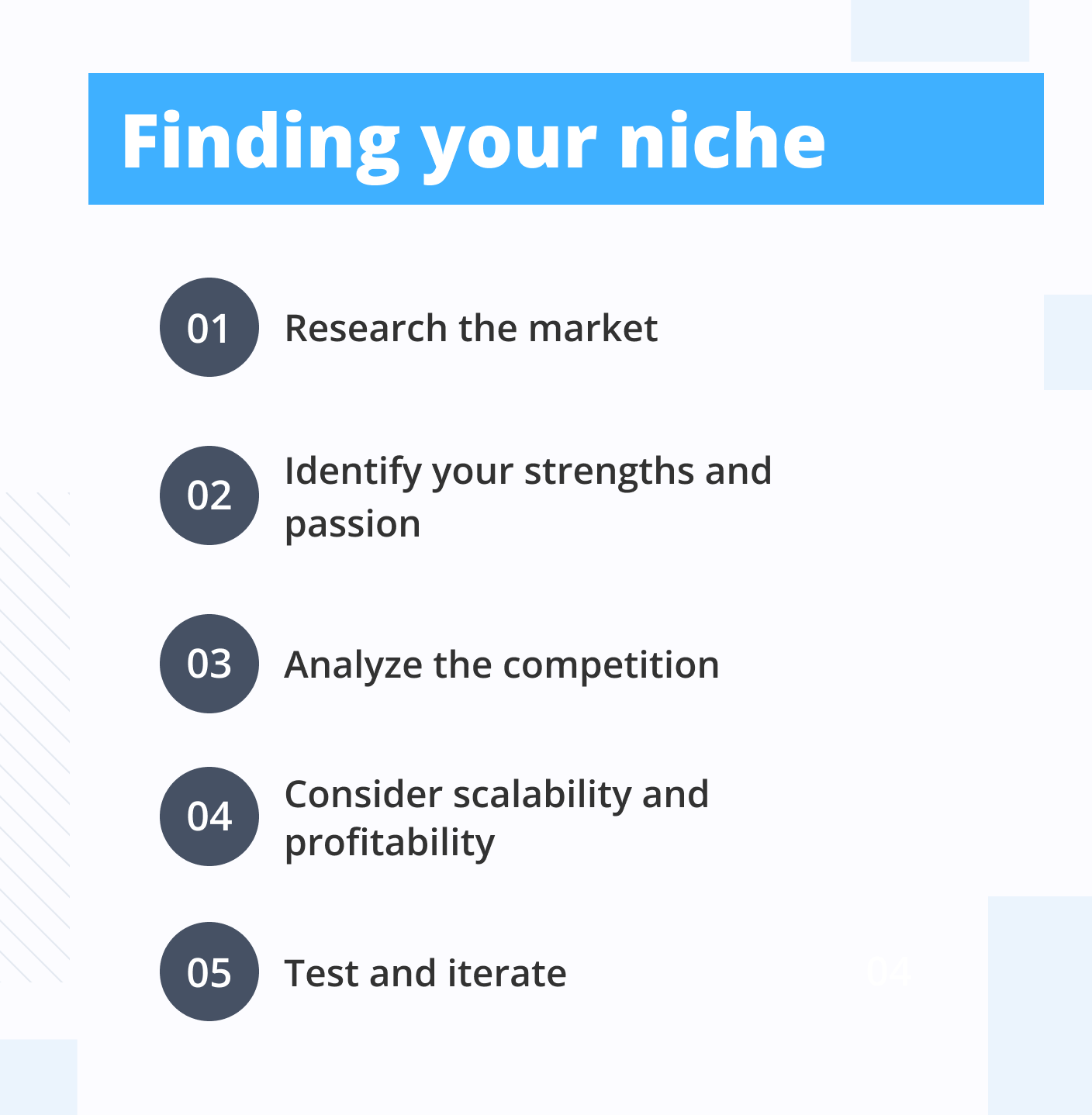
If you have already found your product, use that to find the ideal customer base. If the search for goods is still on, then consider a consumer bracket that you most relate to. Once an enterprise has established its buyer personas, it can understand the mind of the consumer better and make informed business decisions that increase its chances of success.
An organization can target an audience of any size, but there are three main categories to consider when doing so:
- Demographics – this refers to the age, gender, occupation, education, and income, of your buyers.
- Location – the geographic markets where your consumer lives.
- Interests – The audience’s hobbies, beliefs, lifestyles, and other psychographic qualities.
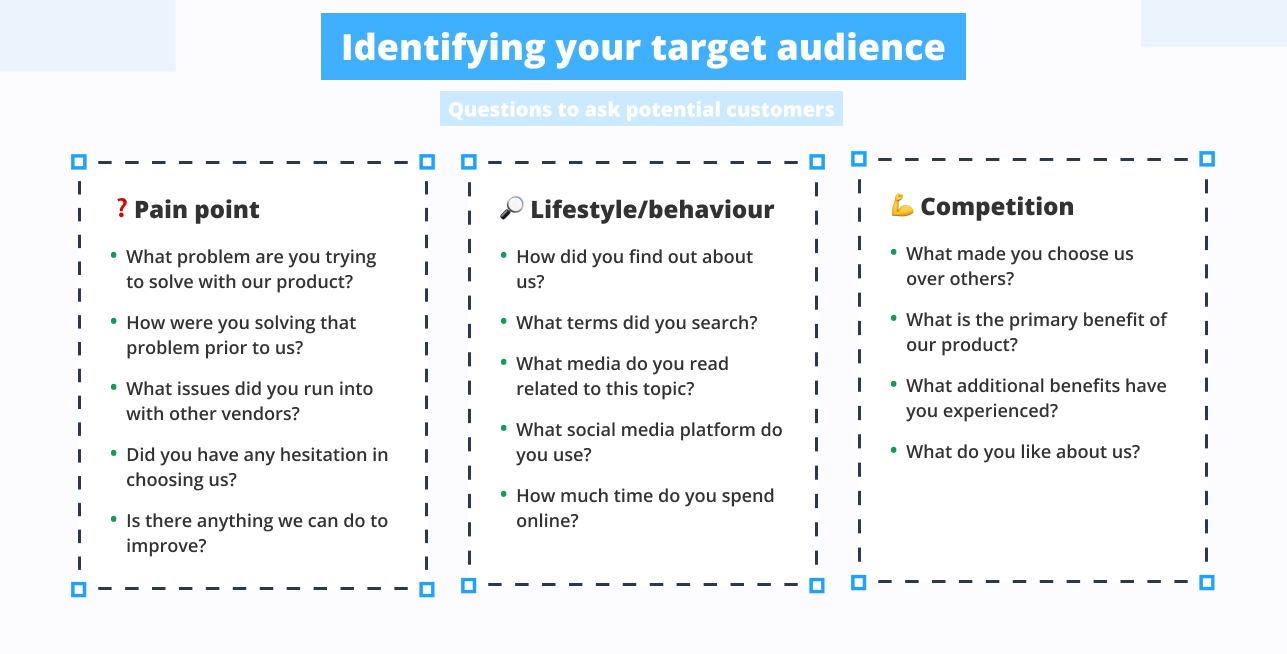
If you already have an audience, here are the questions you can ask them before launching your store.
Crafting your business plan and model
The online business is very diverse in atmosphere. Even big conglomerates like Amazon, started as niche retailers. So the next step after finding your niche is to do a thorough study of the e-commerce market and find the right focus areas.
- Do a SWOT analysis.SWOT stands for strengths, weaknesses, opportunities, and threats. It is a simple and effective way to assess the market you are entering and help develop your product ideas accordingly.
- Locate the industry gaps. By doing targeted research, businesses can find unfulfilled consumer demands in popular product categories and market directly to these audiences. Some of the common ways to identify the gaps are social media platforms – to see the people's complaints, recommendations, and concerns; Google Trends – to compare the search volume of product types, and look at the bestselling goods on Amazon and eBay – by reading reviews and seeing tutorials.
- Analyze your buyer personas. The top online store ideas are created at the intersection of the audiences' needs, preferences, and interests.
- Choose the right business model.Part of your consumer research includes the best way to reach your potential clients and what business model to adopt. For instance, there are Business to Business (B2B) – selling to wholesalers and enterprises, Business customer (B2C) – marketing directly to consumers; Online marketplaces – like Amazon, eBay, etc; dropshipping – order fulfillment via third-party manufacturers; direct-to-consumer(DTC) – eliminates the intermediary.
Selecting the perfect e-commerce platform
Your website is the face of your brand and your first line of interaction with your audience. One of the biggest decisions you will make while creating your online store is the platform you will use. An e-commerce builder not only lets you create your web pages, but also helps make sales, builds trust, fulfills orders, and provides customer support. When deciding what website builder to use, there are a few key features to look out for:
- Usability. Make sure your chosen application is easy to use and intuitive. It should provide easy integration and a drag-and-drop feature to create your online store.
- Great customer support. Look for a platform that offers instant customer support and quick help guides. When you start your entrepreneurial journey, you will need all the help you can get.
- Smooth checkout process. Many customers leave a web page at the checkout process, mostly if the process is difficult to understand. By streamlining this step, you are ensuring more sales and making it easier for shoppers to buy your products. Your website builder should offer convenient integrations with payment portals for smooth functioning.
- Web hosting. Last but not least, the builder platform needs to provide web hosting to let consumers access your online store. Some software offers web hosting built-in, while others require you to use a third-party solution.
When choosing your e-commerce platform consider your current and future needs. Some applications may be great for short-term solutions, but a powerful no-code website builder like SpreadSimple can get you set up quickly and also support your requirements for future growth.
Designing your store for maximum impact
Now that you have your e-commerce platform, we move on to website design. It is a critical aspect of launching your online store. The template you choose for your brand can easily make or break your business as it can either distract your customers and reduce sales or aid in your store’s growth and initiate more conversions.
When a business is designing their website, they should answer the following questions for themselves.
1. What style fits your brand name?
Customers make up their minds the moment they get a glance at your home page. Your style often tells them everything they need to know about your business. For instance, if you are dealing in Gen Z fashion, the flashier your web page the better, but if you are selling outdoor gear, a simpler straightforward design is the way to go. Make sure that the business image and customer base coincide with the layout you have selected.
2. How do you want customers to navigate your website?
As per a recent study, an average user spends about 54 seconds on a web page before deciding to abandon it. So your website must be user-friendly and easy to navigate for customers. Building a smooth seamless operation that is intuitive, will help businesses keep their consumers on the web pages longer and aid in higher conversions.
3. What features do you need the online store to have?
The last important aspect to consider is the features you would want to include in your website. They are among the first things that audiences want to see in your store. Put yourself in the shoes of your potential customer and ask what are the things you would like to see on a web page. For example, brands can start with an About page, photos, and videos of their products, easy access to the shopping cart, a smooth checkout process, etc.
Some points to keep in mind when designing your website:
- Choose a pre-installed template. There is no need to make your work harder and reinvent the wheel. Most website builders offer lots of design templates that can be customized to match the look of your brand. Businesses can observe their competitors and major retailers, and accordingly choose a design that makes them stand out. The design should also incorporate a seamless user experience and not be cluttered with unnecessary terminology and useless buttons that do not resonate with the target audience.
- Follow the three-click rule. Popular research has found that as a general rule, your goods should be accessible within three clicks. What this means is, that the consumer should be able to go from your landing address to the product page without having to dig through many layers. Also make sure to include key links such as shipping information, returns policy, and contact information on the checkout page.
- Make your product the king. The website should always highlight the goods being sold. The design should reaffirm your area of expertise with the help of clear page headings, search bar menus, and powerful imagery. For example, if you are a t-shirt company, then the meta title should have some reference to this like a T-shirt store mention.
- Have clear calls-to-action (CTAs). At every stage of your consumer’s sales journey, they should know what to do next. This can be achieved by creating button text and other prompts that are compelling. The user should know exactly where each click takes them.
- Incorporate detailed product descriptions. When there are so many steps involved, it is easy to get lazy with your descriptions. But failing to do so can drastically affect your sales, have an impact on SEO and brand building, and influence your return rates, visibility, and conversions.
- Add more images. Most customers make their buying decisions based on visual interpretations. This means having excellent product images and videos can help showcase the look, feel, size, dimensions, etc of the goods and can aid in higher sales and conversions.
Simplify your online store creation with SpreadSimple
SpreadSimple is a powerful no-code website builder that creates feature-rich online stores using just Google Sheets. The spreadsheet works as a content management system (CMS) for the platform, which means you can update your product information in just a few clicks by editing your sheet.
SpreadSimple provides all features necessary on for e-commerce websites, including shopping carts, flexible order form, advanced navigation settings, product information, promo codes, multiple payment options, and easy integration with online tools. With SpreadSimple, you can avoid complex coding and save you time and money while building a fully functional online store.
How to create an online store in SpreadSimple in 8 steps
Step 1: Sign ininto the service using your Google account.
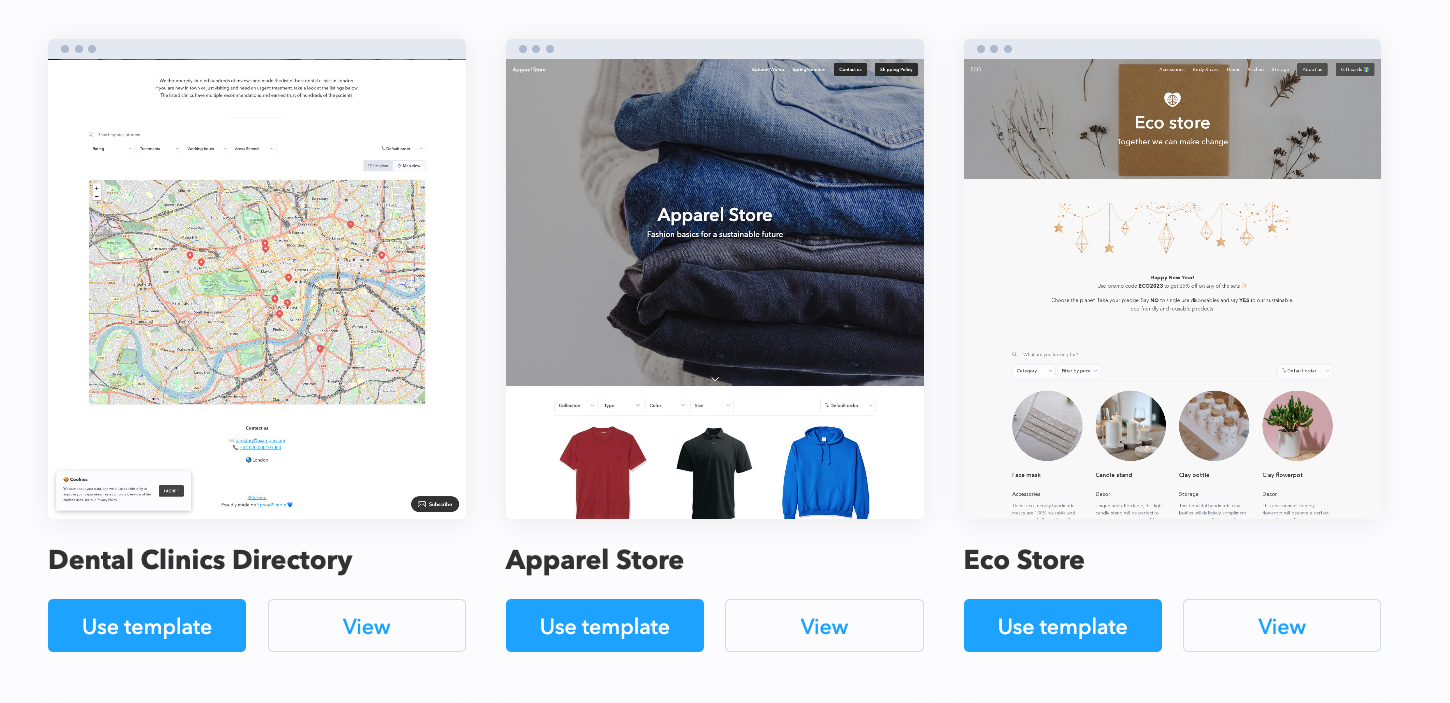
Step 2: Choose one of the e-commece templates to kickstart your project.
Step 3: In the automatically created Google Sheet, add all the product information you want to be shown on your website.
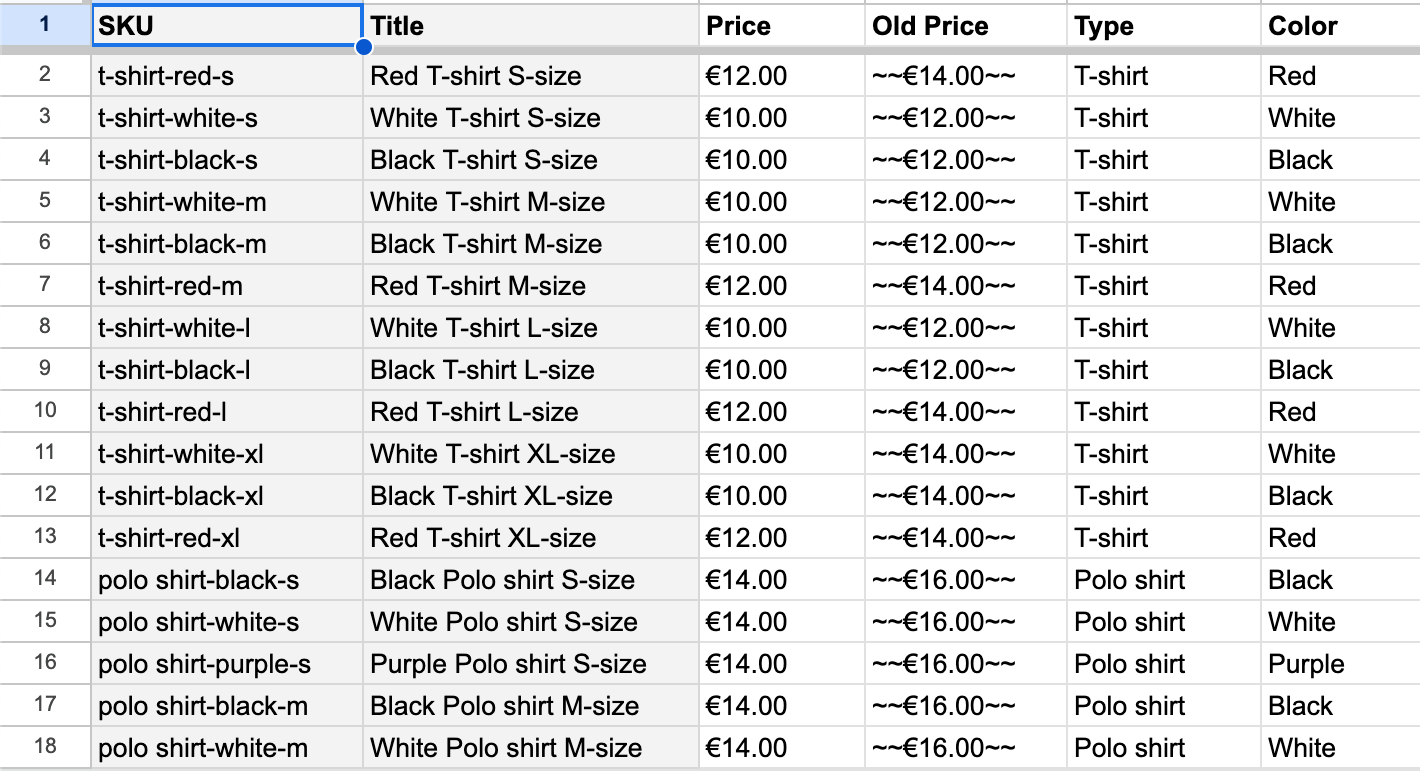
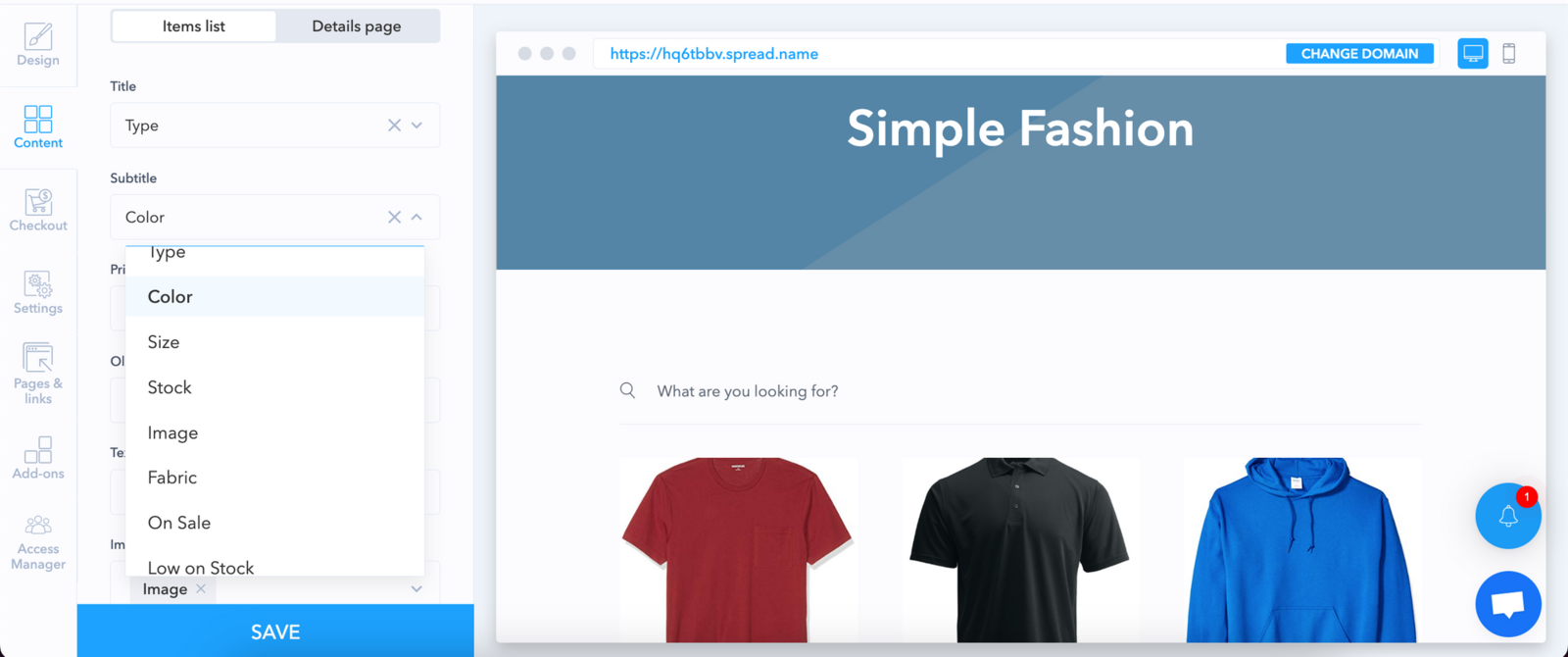
Step 4: In the Content tab, set up the look of the Items list and the Details pages, select the navigation features, and adjust the rest of the features to your liking.
Step 5: Go to the Design tab to add you brand design to make the website truly yours.
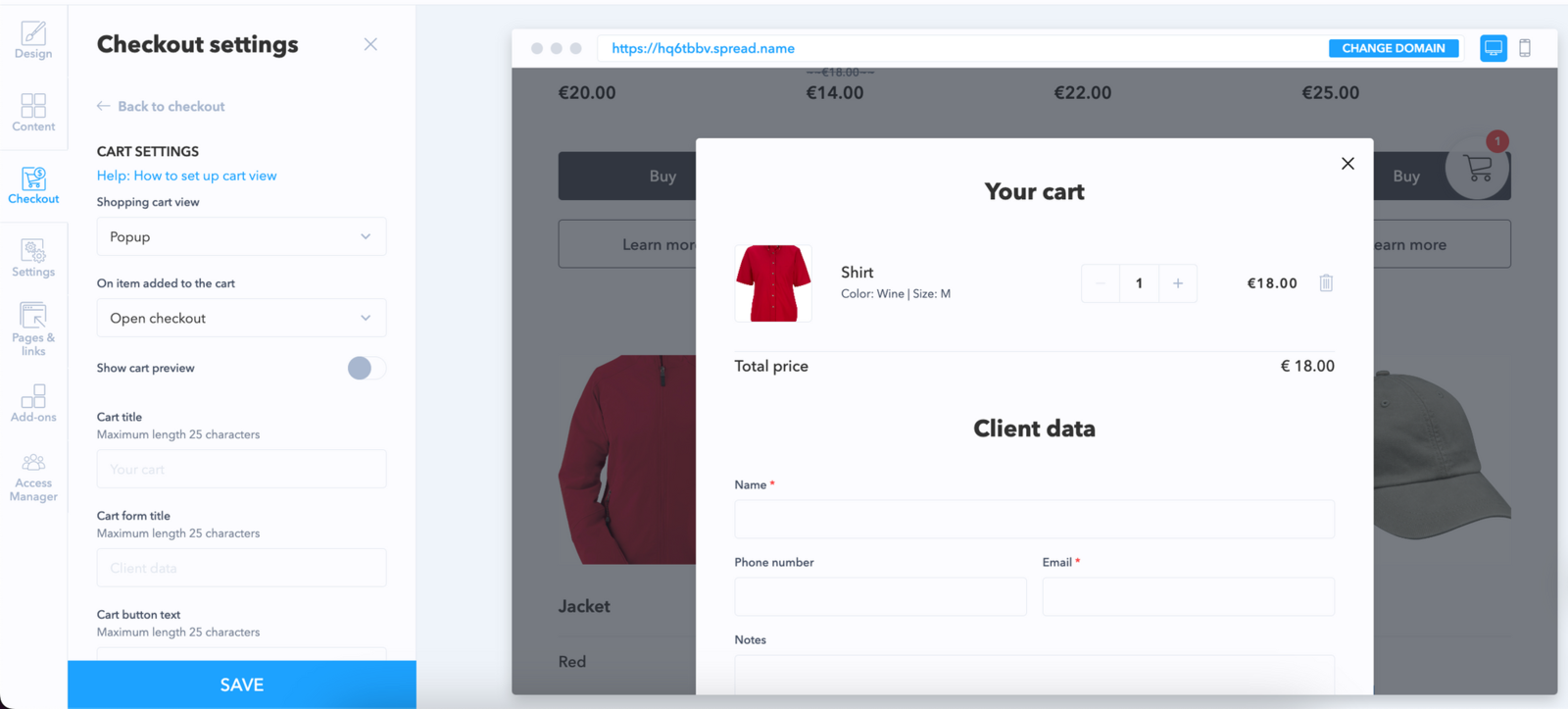
Step 6: Set up the Shopping cart and Order form.
Step 7: Select different payment providers for your website, such as PayPal or Stripe, to ensure enhanced user experience and aid in brand loyalty.
Step 8: Launch your online store and spread the word.
And just like that, you will have your store up and running in 8 simple steps and less than 30 minutes. Best part — you don't need any coding experience for that!
Later, when you need to add more products to your website, you will just need to edit your Google Sheet, and the website will update accordingly.
Listing your products effectively
As we have mentioned already, your products should be listed in an effective way to ensure a successful online store. If the goods are visible to the audience, they will likely stay longer on your platform and probably convert to a consumer. When displaying the products on the main website remember to include three things:
- Product descriptions. A detailed description of the product helps address a customer’s queries and concerns and helps resolve their problems. Make sure to list all the features, uses, quality information, and primary benefits, in a comprehensive way to aid in making a sale.
- Product images.As already stated, consumers are visual learners, and they relate more to the goods if they can see the images of the actual product. Businesses should not skimp on photography, and hire a professional cameraman to do the shooting. If there are budget restraints, they can always create a homemade shoot setup for capturing attractive e-commerce images. According to a recent study, researchers found that implementing 360-degree product photos can help increase conversion rate by 13%, so maybe organizations should consider adding such pictures for high-value items like electronics, furniture, designer clothes, etc.
- Product categories. Last but not least, categorize your products as per their taxonomy to make them more discoverable to your target audience. By displaying your catalog on different web pages, you make your inventory streamlined and reduce your consumers’ sales journey giving them a more user-friendly experience.
Setting up secure payment options
Before launching their online business, entrepreneurs must establish payment options for their website's target audiences. The payment methods you provide the customers at the point of sale(POS), can help establish a larger base of consumers and build brand loyalty. Most e-commerce website builders provide easy integration with multiple payment portals including applications like PayPal, Stripe, Google Wallet, Apple Pay, and Square.
No matter the business type, payments are a core component of an enterprise and affect its success directly. There are no shortages of payment processing services, but prioritizing customer experience with an efficient platform will ensure higher trust and conversions in the long run. Make sure you take into consideration the security features, acceptance of international transfers, fee structure, speedy checkouts, and ease of operation for your users. If you would like to explore this topic further, please refer to our article E-commerce payment processing essentials.
Finalizing your shipping strategy
One of the last things to figure out before marketing your business is how will the products reach the customers. Effective e-commerce shipping strategy is important as 56% of consumers will not purchase from a retailer if they have a bad delivery experience. Furthermore, having an efficient shipping policy can establish the right expectations among your potential customers and ensure a repeat sale. When creating a shipping policy, consider answering these questions:
1. What are the shipping fees being offered(flat rate, free, or variable)?
If there is a realistic way to offer free shipping with your product, then try implementing this as it encourages more buyers to have a higher average order value. Otherwise, consider using a tiered flat fee structure for different types of deliveries such as standard, priority, 2-day, etc.
2. What carriers are you planning to work with?
Different carrier companies like DHL, FedEx, USPS, etc, offer varying shipping rates, delivery times, and goods restrictions. Try considering all the options available and prioritize the ones that are giving you the best price-to-value ratio. For instance, a cheaper provider might not feature damage insurance or deal in bulky items. So it would make sense to work with an established brand that can help with future growth.
3. Do you plan to ship internationally?
If the product being offered has international appeal, make sure that your shipping carrier can also fulfill international orders. For example, start by selling goods to neighboring destinations (like Canada and Mexico if the business is based in the USA) and then look into international fulfillment strategies.
4. Do you intend to offer BOPIS options?
BOPIS, or Buy Online, Pickup in Store, is a quickly growing option for many new retailers. If your business has a physical storefront, then BOPIS would make a valuable alternative that can help make your consumers' lives easier and also build trust with them.
Marketing: spreading the word online
Now that the online store is up and running, it is time to spread the word and take on sales. By using a variety of marketing strategies you can drive potential customers to your online business. There are primary two tools that can be used to achieve this:
Organic marketing tools
- Social media marketing. For this type of marketing, businesses need to create a company identification on social media platforms like Facebook and Instagram and target their audiences. They can leverage their channel as a sales and customer service platform. Some applications like TikTok and Instagram also support direct checkout options on their platforms. Enterprises can use influencer marketing to build brand loyalty and use it as a trust signal on their store website.
- Email marketing. Emails might seem like an idea from the past, but they happen to still be a very effective means of communication with potential customers. Start by creating a business email address and then develop a list by adding a signup option on the website’s checkout page. You can also offer a special discount or another incentive, like gift cards if a user joins the email list. Then create a strategy and send out regular newsletters, promotions, updates, and product recommendations to the list. Make sure that you are adhering to privacy regulations and laws of the country.
- SEO. SEO is the best marketing strategy to optimize your website’s SERP ranking on Google. It helps draw organic traffic toward the store while building long-term brand awareness. Some ways to achieve this are by adding meta titles and descriptions for each web page and following other practices like using free Google Analytics and taking advantage of free tools.
- Loyalty program. A loyalty program is an excellent way to secure repeat customers and increase your consumer's lifetime value rates. This can be achieved by offering rewards for each order, or special actions like sharing the product reviews on social media platforms, referring a friend, etc. It is great for driving more attention to the website while taking good care of your existing clients.
Paid marketing tools
- Facebook and Instagram advertisements. The respective platforms offer various strategic ad placements, that help businesses target certain demographics or interest groups. Facebook and Instagram have also started plugins that can be directly applied to your website dashboard which optimize the ads around the clock using AI.
- Google Shopping advertisements. These are pay-per-click (PPC) ads that help websites skip to the top of relevant search results. When a customer clicks the link they are sent to the landing page directly or a Google Checkout page based on your settings.
If you are curious to know more ways to market your online website, then refer to our other articles – Ways to Find Customers for Your Product and 10 Free Advertising Platforms to Promote Your Website Online.
The final checklist before launch
Now that the online store is up and running, it is crucial to do a final checklist to avoid making common mistakes that can hinder your success. Here are some key errors to stay away from:
- Lack of planning and research – Before diving headfirst into the world of e-commerce, make sure you have done thorough market research and developed a detailed business plan. This will identify your desired target audience, find the business niche, and analyze competitors. It will also help in answering questions like what customers are looking for. How can you convey the right message to your consumers? And what makes the product unique as compared to the competitors?
- Poor product selection – Selecting the wrong product that does not resonate with your target audience. By selecting a relevant good, that has a good profit margin, and is easy to source or create, you can avoid overstocking, increase the demand, and aid in conversions.
- Improper website design – Make sure you have invested time and resources to create a professional-looking user-friendly website that offers easy navigation, clear product descriptions, high-quality images, and a seamless checkout process.
- Ineffective marketing and promotion – Do not rely on only one channel of marketing like direct traffic. Promote the website actively through various channels like social media, email marketing, SEO, and targeted advertising.
- Neglecting customer service – Even if you do everything right but fail at customer service, then your brand name takes a big hit. Try to prioritize excellent service to build loyalty in the long run. This can be done by responding promptly to inquiries, addressing concerns quickly, and handling returns efficiently.
- Not prioritize shipping and fulfillment – Find and establish a reliable and cost-effective shipping carrier for an efficient order fulfillment process. This will ensure timely delivery and overall customer satisfaction.
- Lack of proper financial management – Using financial management tools, you can keep accurate track of expenses, revenue, and inventory. They will help you make informed decisions and ensure profitability along with growth.
- Failing to adapt and evolve – Just because the online store is active does not mean you can relax. Keeping the business up-to-date with current trends, customer preferences, and recent technological advancements will help to continuously improve your marketing strategies and offer better products.
Besides the above-mentioned points, also make sure to avoid these E-commerce Mistakes.
Conclusion
Whether you are a digital artist, retailer, entrepreneur, or influencer, today’s e-commerce platforms make it simple to start selling online. Everyone’s business journey is somewhat different, but what stays constant is the underlying setup process. You need to find the ideal e-commerce platform, set up your product catalog, tweak design and other configurations, and promote your business through marketing strategies. Just remember, every e-commerce journey is a work in progress that is constantly evolving as you learn and adapt. The important thing is to get started today.
Frequently asked questions about launching an online store
How do I choose the right e-commerce platform?
When deciding what platform to use, consider these few key features:
- Usability – Make sure your chosen application is easy to use and intuitive.
- Great customer support – Look for a platform that offers instant customer support and quick help guides.
- Smooth checkout process – Your website builder should offer convenient integrations with payment portals for smooth functioning.
- Web hosting – The application needs to provide web hosting to let consumers access your online store.
When choosing your e-commerce platform consider your current and future needs.
What products should I sell in my online store?
Study the market and research trends before selecting the right product to sell on your online store. Do the following steps to find your niche and select your product:
- Do a SWOT analysis – It is a simple and effective way to assess the market you are entering and help develop your product ideas accordingly.
- Locate the industry gaps – It can help you find unfulfilled consumer demands in popular product categories.
- Analyze your buyer personas – Study your target audiences’ needs, preferences, and interests.
- Choose the right business model.
How can I design my online store without technical skills?
In today’s modern world, you do not need to possess technical skills to create an online store. There are several no-code website creators in the market, that take care of your CMS (Content Management System), hosting, and other needs, while simplifying the creation process. For example, you can use SpreadSimple – one of the most user-friendly no-code website builders that converts your Google Sheets into an online store in a few minutes.
What are the best strategies for listing products?
Your products should be listed in an effective way to ensure a successful online store. When displaying the products on the main website remember to include three things:
- Product descriptions – Make sure to list all the features, uses, quality information, and primary benefits, in a comprehensive way to aid in making a sale.
- Product images – Businesses should not skimp on photography, and hire a professional cameraman to do the shooting.
- Product categories – Categorize your products as per their taxonomy to make them more discoverable to your target audience.
How do I set up payment options for my store?
Most e-commerce website builders provide easy integration with multiple payment portals including applications like PayPal, Stripe, Google Wallet, Apple Pay, and Square. Make sure you take into consideration the security features, acceptance of international transfers, fee structure, speedy checkouts, and ease of operation for your users. If you would like to explore this topic further, please click on the following link – E-commerce payment processing essentials.
How can I effectively market my online store?
There are primary two tools that can be used to achieve this:
Organic marketing tools
- Social media marketing
- Email marketing
- SEO
- Loyalty program
Paid marketing tools
- Facebook and Instagram advertisements
- Google Shopping advertisements
If you are curious to know more ways to market your online website, then refer to our other articles – Ways to Find Customers for Your Product and 10 Free Advertising Platforms to Promote Your Website Online.
Can I start an online store with a limited budget?
The easiest way to start an online store with less money is to sell services or digital products and choose a website builder. The cost of an online business varies depending on the platform and the features you need. Some applications are free to use (like SpreadSimple), while others have a monthly fee. There are e-commerce solutions for less than $15 per month.
What legal considerations do I need to know about?
Starting an online store involves lots of legal requirements which can differ from country to country.
- First choose a structure, such as a sole proprietorship, LLC, or corporation, and register your business with the authorities.
- Obtain an Employer Identification Number (EIN) from the IRS.
- Ensure you have the necessary licenses and permits, which vary by location and type of business.
- Comply with online business regulations, including consumer protection laws, privacy policies, and terms and conditions for your website.
- Understand and comply with tax obligations, including sales tax collection and remittance.
- Lastly, consider trademarking your brand to protect your intellectual property.
How do I track and improve the performance of my online store?
Tracking the performance of your online store requires using various tools and metrics. Start with something like Google Analytics to monitor traffic, user behavior, and conversion rates. You can also use your platform's built-in analytics to track sales, order volume, and average order value. Monitor KPIs such as customer acquisition cost, consumer lifetime value, and cart abandonment rate to identify patterns and trends which will help in understanding user behaviors and aid in making data-driven decisions.