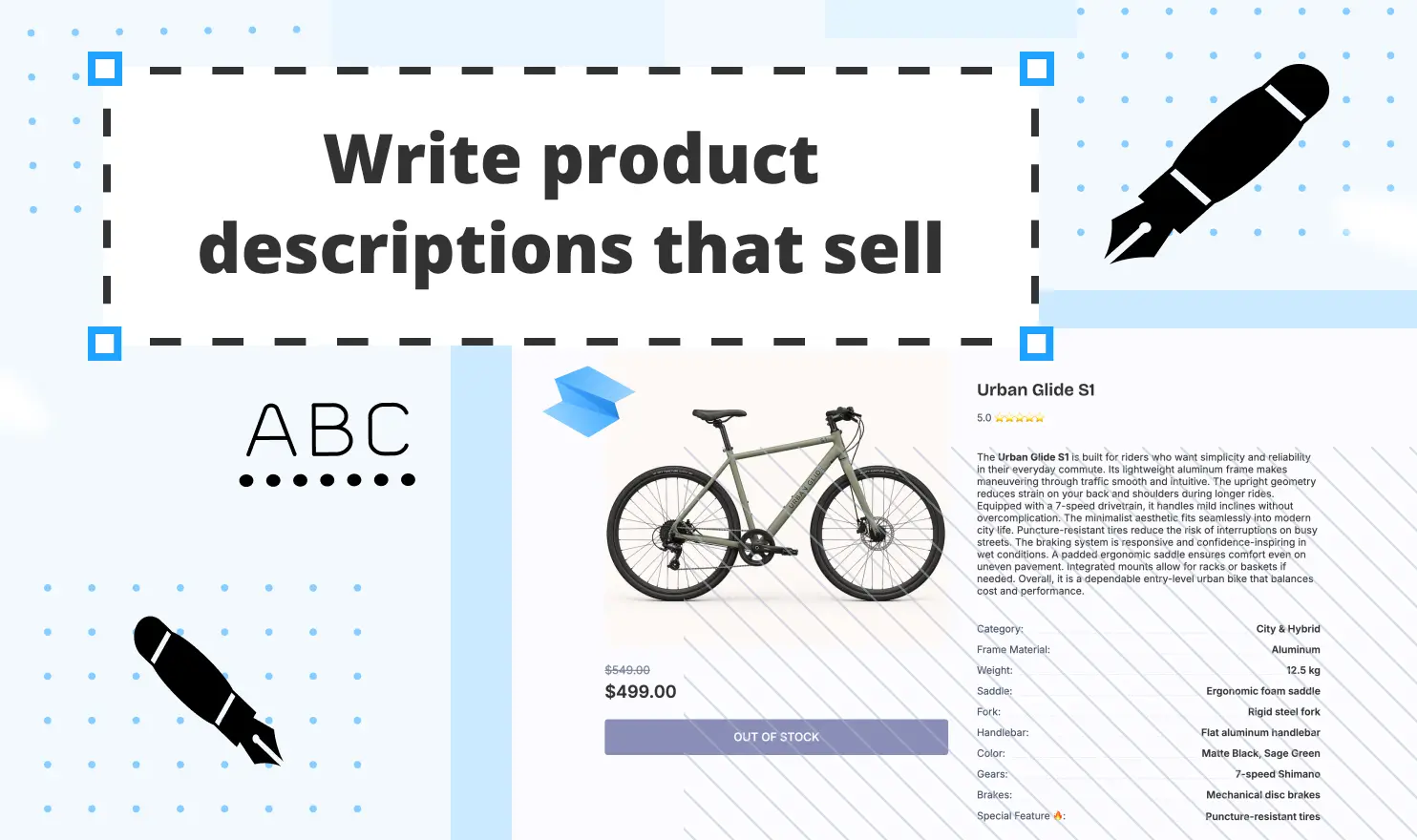
Let’s start with a simple task: try picturing an online shopper’s behavior pattern on your website. Let’s say the product photo caught their eye, and the price looks fair. Then they scroll down to the description and find generic, yet meaningless cliché phrases like "High-quality item. Great for everyday use." Unmotivated and lacking the necessary details, they close the tab. You didn't lose that sale because of the product, the price, or the photo. The text didn't give the potential buyer a compelling reason to say yes.
Why product descriptions matter more than you think

Product descriptions shouldn’t be underestimated. Text, layout, and keywords carry a lot of weight. Baymard Institute (opens new window), which has spent years usability-testing e-commerce sites, notes that nearly every user goes through a product page before buying. Often, they take the final decision regarding the purchase right there.
Here are the key takeaways from the Baymard Institute research you should keep in mind when writing product descriptions for your website:
- A detailed enough description motivates people to buy. If it is too brief, visitors often leave the page, and sometimes the whole site.
- If information is missing, some users might fill the gaps with wrong assumptions. That leads to frustration and unnecessary returns.
- Online shoppers can't ask a shop assistant. Even with an available chat widget, almost no one uses it, so the description is sometimes all the buyer has.
- Visitors who see only one brief description often come to a conclusion that the whole website’s quality is low.
- The desktop study of the beauty industry shows that 50% of the shoppers need ingredient information. If they can’t find it, they quickly switch to a product that lists it.
There's also a competitive angle. Baymard reports that most of the top 60 e-commerce sites maintain consistently detailed descriptions. That is the standard shoppers expect. A weak product description is therefore likely to drive buyers away.
And the stakes are broader than one page. Baymard's cart abandonment statistics (opens new window) put the average abandonment rate at around 70%. Not every abandoned cart is a bad product description consequence, but every unanswered question gives a hesitant buyer a valid reason to leave.
Rule 1: Tell a story, but don't drown the facts

The usual advice is "don't list features, tell a story." It's a good recommendation with a risk that many people tend to overlook. Follow it blindly, and you might end up with a manuscript loaded with atmosphere and no dimensions.
To avoid this common writing mistake, let’s take a look at classic literature. Ernest Hemingway built his style on the iceberg theory, also called the theory of omission. The surface of the text is minimal and concrete, and the deeper meaning sits underneath, implied rather than explained. His dialogue and descriptions are very short, yet they make an instant, unforgettable impression, because every word was chosen carefully to carry weight.
What does a Nobel Prize-winning novelist have to do with your online store? Roughly put, your description has the same constraint: few words, and only one chance to make an impact. So you must find the strongest, most specific phrases and cut everything else.
In practice, that means:
- Open with one powerful image or situation your potential buyer recognizes (based on the research we explain below).
- Put the most important facts (size, material, weight, etc.) right after it, each on its own line.
- Let the buyer draw the conclusion. "Fits in a coat pocket" is more illustrative than "extremely portable."
Rule 2: Picture your buyer and appeal to their imagination

Before writing anything, decide who's reading. A new, viral product, for example, often attracts people who have never tried it before. Professional equipment is searched by experienced shoppers seeking reliable performance and knowing exactly what they want.
That tells us two things about what the description must do:
- Say the product is beginner-friendly. A newcomer's silent question is always "Will I be able to use this?" Trending mass-produced products like viral sports gear, AI tools, etc. should be explained for somebody with zero knowledge in the field.
- Niche-specific, professional equipment and software, on the contrary, is usually purchased by buyers with experience. Make sure to include all the technical specifications that elevate the product among competitors.
Use descriptive language. It makes readers visualize the entire experience, and visualizing is halfway to wanting. Your best tool is sensory, doing most of this work. They're especially useful for food. A pie described as warm, gooey, and buttery makes your taste buds react before your brain gets involved. For physical goods, think about touch, sound, weight, and scale: smooth, snappy, featherlight, palm-sized, etc. Give the exact numbers in the product specifications and the human-scale translation in the description part.
Rule 3: Forget "very good"
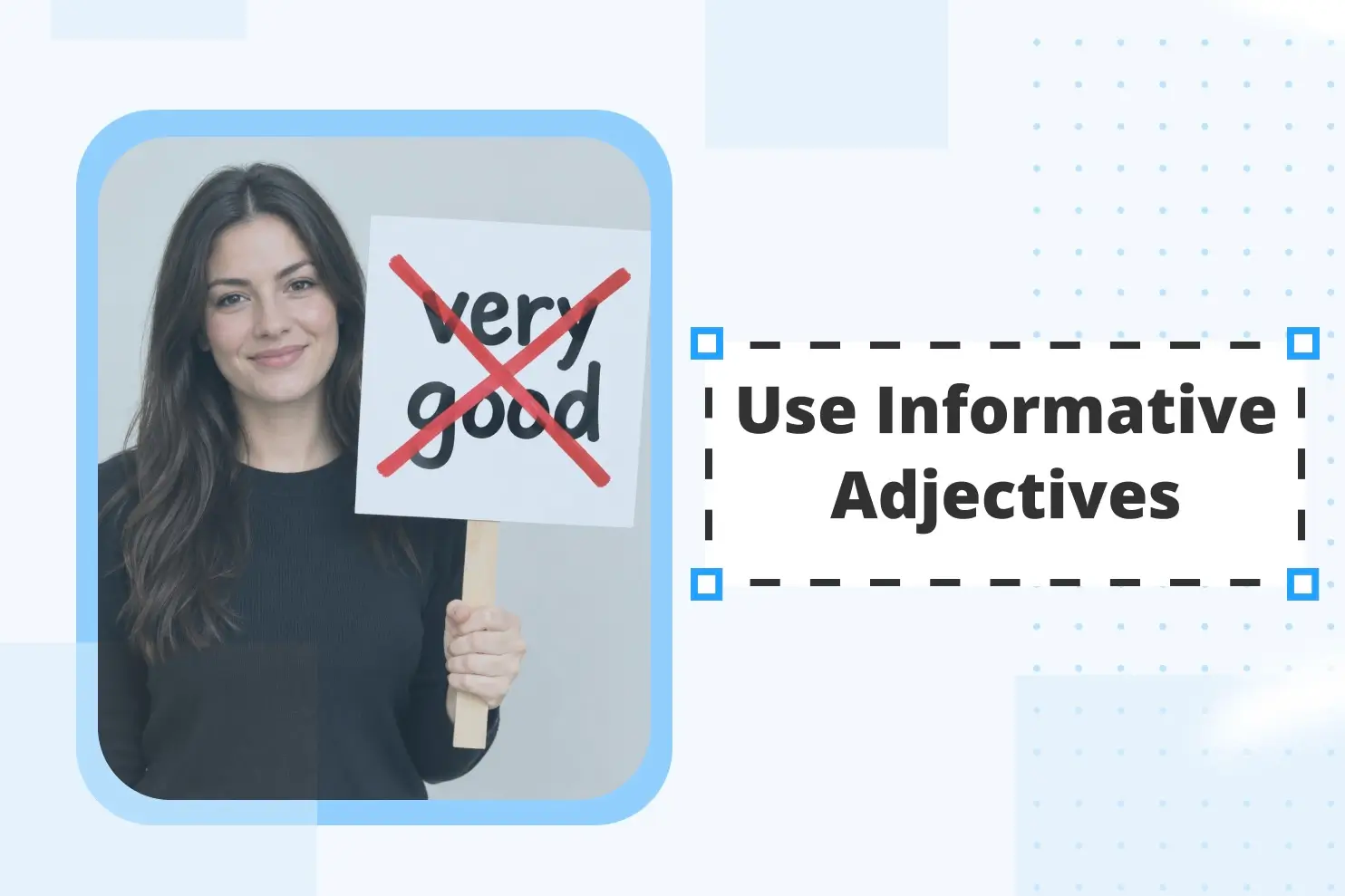
Hemingway's iceberg theory also works as a filter for adjectives. If a word doesn’t convey any contextual meaning, get rid of it.
Adjectives like very good/amazing/great should be featured in the website’s reviews section. Ask what very good actually means for your particular product. Then use words that carry that meaning. Each one answers a real question about how the product behaves:
Finished with easy-to-style colours, its visible cushioning adds comfort to your journey. (https://www.nike.com/ro/ (opens new window))
True-to-life color and unparalleled brightness and contrast. (https://www.apple.com/ (opens new window))
Want the most youthful, luscious looking lips of your life? Revive, replump and retexturise the look of your lips with my Life Changing Lip Mask! (charlottetilbury.com (opens new window))
Here's how the rules work together. This is the kind of description that loses sales:
Luxury Scented Candle
This amazing candle is perfect for your home. It has a beautiful design and a wonderful fragrance that creates a relaxing atmosphere. Made with high-quality materials, it is a great addition to any room.
And here's an improved text that follows the above rules:
Cinnamon Vanilla Soy Candle — 250g
Fill your home with the warm scent of creamy vanilla and rich cinnamon. Made from natural soy wax, it provides up to 25 hours of an even, clean burn. The reusable glass jar adds a minimalist touch to your interior. Perfect for slow evenings, relaxing baths, or cozy nights at home.
Both versions are brief, less than 100 words, but only the second text creates a relatable lifestyle image that helps customers visualize owning and using the product, while answering numerous silent questions: scent, materials, durability, sustainability, etc.
Rule 4: Research your customers, then prove your claims

An in-depth market research requires professional tools and expertise. But you can start with browsing marketplaces, Reddit, Instagram, or TikTok, finding posts about similar products, and reading the comments. That's a free, up-to-date list of questions your description should answer.
Next, get into SEO to improve search engine rankings and drive organic traffic. Tools like Ahrefs, Semrush, Similarweb, and Google Trends can show you what shoppers need, which terms competitors rank for, and which phrases are growing.
Avoid overloading the text with keywords. Google's own spam policies (opens new window) define keyword stuffing as filling a page with keywords to manipulate rankings, and pages that do this may rank lower or disappear from results.
Rule 5: Write for your ideal customer

You can't please everyone, and trying this makes your product description bland. Decide who your target audience — your ideal customer — is and write to them. Think about what they value, what makes them hesitate, and what they'd ask about the product if you could have a tête-à-tête dialogue with them.
Treat your description as one side of a dialogue. If you ever feel lost while writing, focus on three key questions about the product:
- How does it benefit the buyer?
- How does it make them happier?
- How does it make them healthier?
Nearly every purchase can be narrowed down to those three motives.
Take inspiration from sports brands that are pros at this. Browse a few of their product pages and notice that they often go beyond fabric, weight, and size. The real message is that this particular tennis racket or this shoe helps you play your best and enjoy the moment. Specs support the promise but don't replace it.
Rule 6: Structure the text for scanning
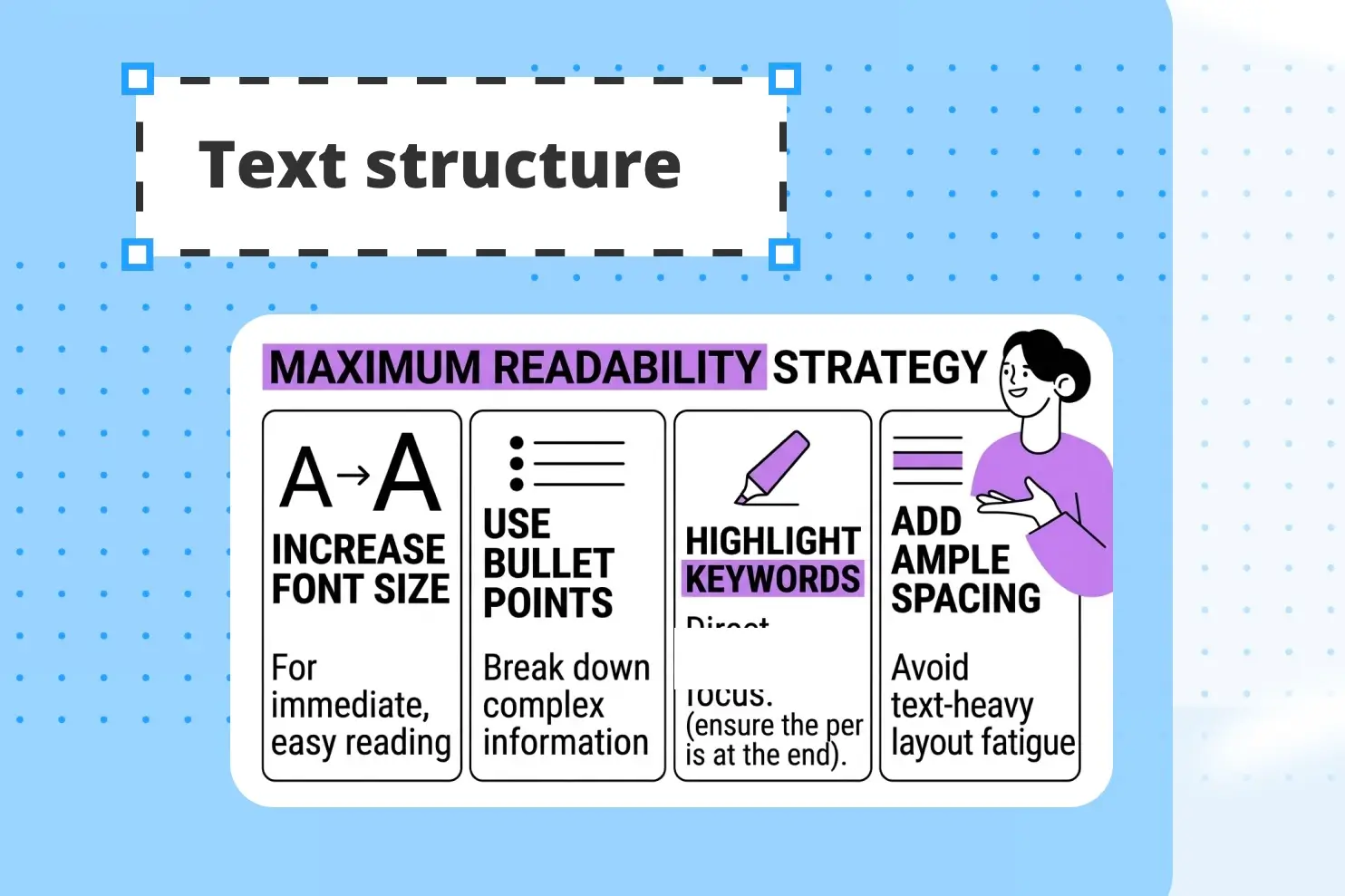
You can write the best text in the world and still lose the reader, because most visitors don't read. Nielsen and Morkes (opens new window) pointed out that the majority of users scan a new page instead of reading it word by word.
So structure your text accordingly:
- Put the core information on separate lines: dimensions, materials, weight, brand, and other specs. It's easier on the eyes than a paragraph.
- Use bullet points for features and what's included.
- Highlight keywords in bold, but sparingly.
- Increase font size and spacing for visual comfort.
- Start with a highlight. Baymard has published research showing that structuring descriptions by "highlights" (opens new window) increases engagement, yet 78% of sites don't do it.
A simple template that works for most products:
- A headline with the benefit.
- Two or three sentences that set the scene.
- A short bullet list of highlights.
- A "Details" block with specs, one per line.
- What's in the box, plus care or compatibility notes where relevant.
SpreadSimple: your online catalogue with compelling product descriptions
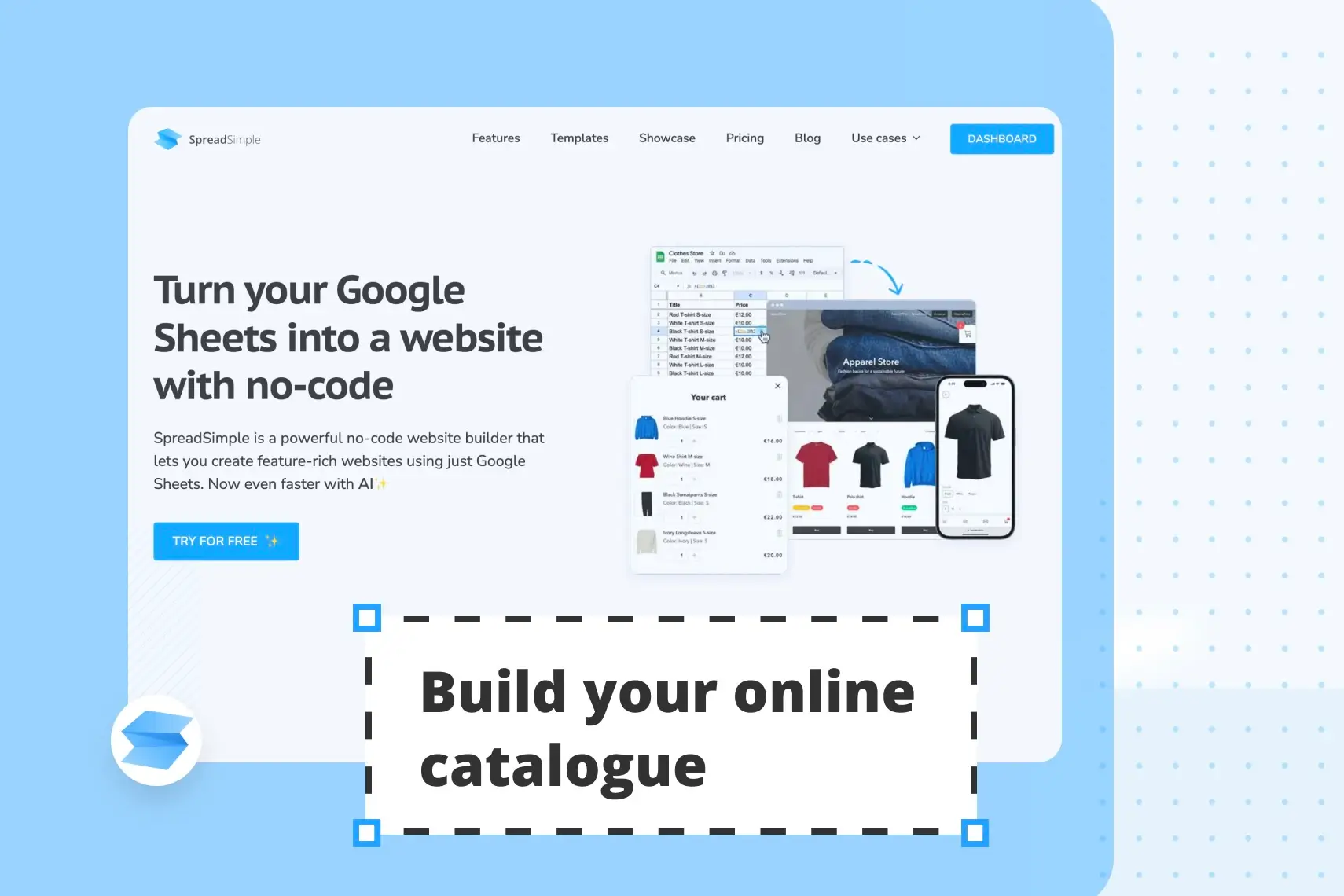
Writing an engaging, well-structured text block is an essential skill, but you also need an efficient way of keeping descriptions consistent across dozens of products, and that's where the user-friendly website setup matters.
In SpreadSimple, your catalog lives in a Google Sheet. One row is one product, and columns hold the title, price, description, and other details. Updating a description means editing a cell, not rebuilding a page. That makes it easy for non-technical users to apply the structure above to every product: a short story line, a bullet list of highlights, and a "Details" block, in the same order each time.
Here’s how SpreadSimple helps to implement the writing tips we just described:
- Detail pages for each product. Each item gets its own page, so you have room for the full description, specs, and images instead of a cramped card.
- Filters, search, and price range. When buyers compare products, they compare on specs. Consistent data in your sheet makes filters useful. The Bike Store template is a good model for spec-heavy catalogs: category pages, a price filter, detailed product pages, and variations like size and color.
- Stock limitation. When something sells out, the "Add to cart" button is disabled automatically. A product described beautifully and then unavailable at checkout causes a lot of friction and loss of trust, and this avoids it.
- Built-in Markdown editor. Highlight keywords, add links, specification lists, etc.
- Built-in SEO settings. Set titles and descriptions per page to end up in search results.
If you're selling physical goods, start with the e-commerce template or browse the full template library. You can start on a free plan and upgrade for a custom domain and other valuable features later.
A quick checklist before you publish
- Does the opening line show a situation or benefit, not a generic claim?
- Can a beginner tell whether this product is for them?
- Are vague adjectives ("very good", "high-quality") replaced by specific words or examples?
- Are dimensions, materials, weight, and what's included on separate lines, with units?
- Have you answered the top questions from social media comments and reviews?
- Does the main keyword appear naturally, and is the text free of repetition?
- Can the page be understood in five seconds of scanning?
FAQs
How long should a product description be?
A simple product may need 50 to 100 words plus specs. A technical one needs more. Baymard's testing suggests that too-short descriptions are risky because shoppers read them as a sign of low quality.
Should I write my own descriptions or copy the manufacturer's?
Write your own. Manufacturer text is used by every other seller, so it gives you no way to stand out, and duplicated content doesn't help your search visibility either. Use manufacturer specs as a fact source, then rewrite the text with your potential buyer in mind.
How many keywords should I use?
There's no magic number, but a keyword density around 2% (and below 3%) keeps text natural. Focus on a primary phrase in the title and text, plus a few natural variations.
Do I need reviews in the description?
Keep customer reviews in a separate reviews section. In the description, you can reference proof, like awards or aggregate ratings, if they are real and recent.
Can I use AI to write descriptions?
You can use it for a first draft, but edit heavily. Add the specifics only you know: real measurements, real customer questions, your tone.
Final thoughts
Convincing product descriptions always respect the reader, without trying to trick them into buying. Give them a picture, the facts, and enough proof to decide. Keep the iceberg theory in mind. Show only what matters, and let the rest be felt.
Start with your five best-selling products. Rewrite each one using the checklist, and compare the results over a few weeks. If your catalog lives in a spreadsheet, it's an afternoon of work.