The ideal way to make people feel like an integral part of something bigger is by building a community center business. It is a powerful way to connect with audiences, grow your brand, and generate more recurring revenue. The online group offers an opportunity to bring like-minded individuals together in a meaningful way.
However, starting a community center from scratch can be an overwhelming task, especially if you are new to this venture. The concept is not just about building a space but delivering an experience that brings people together. The first step requires envisioning the impact that you want your assembly guidelines to have and finding out what is missing. To help our fellow readers, we have compiled this comprehensive guide that will help create a successful community center business.
Understanding the role of a community center
Before we dive into the center programs and market research, let us first define the concept. In layman’s terms, a community center is an organization where members can assemble, engage with one another, and address their concerns. The shared spaces are built around the common interests and goals of the affiliates. The type of society that is created depends on your business goals and what you plan to achieve with them. For instance, a fitness coach may build a sports group for individuals who not only want to practice together but also spend quality time discussing their progress, sharing life hacks, and transformation stories with peers.
For a fashionista or designer, it may be a weekly café club where members talk about the latest Met Gala outfits, environmental impact of fast fashion, and explore trajectories for overall improvement and growth.
Whatever your field of expertise, communities are a powerful way to make meaningful connections with audiences, engage with a brand, be a leader, collaborate on projects, and share advice.
Common types of community centers
Moving on to the different types of community centers, we have compiled a list of the six most common ones a person shall encounter:
- Interest – a network brought together by like-mindedness and passion, like a neighborhood group of single mothers sharing insights, tips, ideas, recipes, and advice.
- Action – a community built on a common goal to bring about change in society and help elevate some backward classes. For example, the Writers Guild comes together and plans rallies, protests, and strikes to make working conditions better for everyone.
- Place – a group formed based on geographic boundaries. Take New York travellers, a community where members are focused on sharing things a person can do when vacationing in the Big Apple.
- Profession – commonly called a community of practice, it is when a group of individuals come together to develop professionally in their field and share tips to excel in their job. For instance, a collective of fashion designers who forms a platform to share concepts that will aid the industry at large.
- Learning – as the name suggests, this type of clan works by sharing learning objectives and knowledge among each other. Those goals may relate to a specific career, hobby, or interest, such as rollerblading or parkour. These communities are very popular among younger audiences.
- Brand – last but not least, a community around a lifestyle, business, or common mission championed by an enterprise or business.
Market research and community needs assessment
The key to establishing any type of organization is understanding the market and people’s needs. So, the first step to building a successful community center is doing research and understanding the gaps in the network. This can be done by conducting surveys, analyzing demographics, joining focus groups, and having conversations with people online to find the cracks in the services and support systems. For instance, an area can experience a problem such as a low literacy rate or high unemployment. Identifying these issues will help a business determine the best course of action forward and the services or programs that the center can cater to.
An individual building a community center needs to be clear about the purpose of the group and who it is helping. These happen to be the foundation for everything the network will do, the kind of people it will attract, the content it will create, and how it will grow. Start with making a list of areas that need improvement in your locality. Some of the common problems faced by communities are:
- Environmental problems & lack of greenery
- High unemployment
- Pollution
- Fitness & obesity
- Safety issues
- Low literacy rates
- Drug abuse & alcoholism
Being specific is always better than being broad. A niche community tends to stand out because it targets the right people. If you have a very general objective, it may not attract the right kind of audience members.
Developing a business plan
A detailed business plan will serve as a roadmap and an investor pitch, all rolled into one. So make sure to develop an idea that clearly articulates your mission and vision, target demographics, budgeting needs, short & long-term goals, operational requirements, and staffing. This document becomes the base guide for your future growth and also serves as a blueprint for convincing investors and partners to believe in your vision. In short, think of it as something that paints a clear picture of where you see your community center a few years down the line. Keep in mind that a detailed plan lays the groundwork for success in any field.
Step 1: Begin the plan with a strong mission and vision that directly impact the community center’s growth. Draft a clear statement that defines the center’s purpose, the likely target audience, and the main services it plans to offer members. For example, if you are running a shelter, the mission & vision should focus on creating a secure space, providing aid and assistance, giving educational materials, and offering job training for future independence.
Step 2: Our next step would be setting up the short and long-term goals of the community center. Initial objectives can include opening the center and launching the core programs, while long-term targets involve expanding services and increasing the reach of the network through various marketing strategies. It is useful to create a list of concrete and realistic goals for your community center as they help in giving direction to your movement and guide the business on its path.
Let's take an example: if the network caters to a certain population, such as single mothers or ethics groups, then make sure to include some of the below-mentioned goals in your list.
- Create a safe space for the community to meet, maybe online or offline, and also provide a venue for overall improvement.
- Encourage members to share resources and provide support for unemployed colleagues through workshops, fairs, and classes.
- Finally, give legal aid to the local immigrant population.
Step 3: Financial projections are the backbone of a new venture as they assist in determining a rough estimate of how much the enterprise will cost. A community center’s budgeting should include start-up costs, building expenses, services charges such as classes, resources, workshops, etc., and operational tariffs. To do a proper budgeting of your community hub, answer the following questions:
- What is the average property rental cost in your area? How much will it cost to buy a premises?
- Check the expenses required to provide certain services in your community.
- Calculate the financial constraints for fundraising, such as mailing invitations, advertising fees, catering, and promoting the event.
- What type of equipment will your business need? Is there any special technology or application you need to invest in?
Step 4: An online community center needs a team of people to operate, maintain, monitor, and support its work. The development of members will require an ongoing commitment from a dedicated staff with a wide range of skills, each contributing to the growth and well-being of the center.
There is a need for executive leadership to guide the community’s goals and market the enterprise. Choosing a support team that helps to carefully balance duties with strategies will help members feel valued and welcomed. The true success of a community happens when its individuals feel appreciated, heard, and acknowledged. This is possible only with proper staffing.
Securing funding and resources
Now that the community center is starting to take shape, let us tell you about the myriad of challenges that lie ahead. The biggest obstacle now standing in front of your community center is securing funding and resources. These ventures require a significant capital upfront for purchasing or leasing property, renovations, operational expenses, staffing costs, etc. In developing this business, you will need to raise significant finance to launch the enterprise. Some of the main sources of funding a center can rely on are:
- Personal savings – getting investments from family and friends or using your own capital helps maintain control of the venture and avoid debt.
- Bank loans – There are many banking institutions ready to help with community centers through loans and credit card financing, but they require a solid, detailed business plan to be in place.
- Angel investors – There are many like-minded venture capitalists and individuals interested in your vision who can be approached for financing. They mostly invest in an enterprise that shows high potential for future growth.
- Crowdfunding – If you are entering a niche market and helping needy people, then platforms like Kickstarter or GoFundMe are great options for gathering crowd-based funding.
- Grants – Many government bodies, foundations, and local and national organizations offer grants for recreational initiatives. Research local and national businesses that will be happy to partner with your mission, especially if it works into their long-term company vision.
When you are creating a strong funding proposal, keep these tips in mind:
- Share your story – Make sure you communicate your vision in a story format explaining what made you start in this field and also the impact your center will have.
- Be concise and specific – Clearly state your requirements in a format that is quick and easy to understand. For instance, present the calculations for your financial needs and how the funds will be utilized.
- Highlight the benefits – Show the investors or enterprises what their benefits would be along with the community, like financial returns, advertisements, and goodwill earned.
- Be professional – Present the data in clear, polished language. Make sure it is professional and not casual.
Legal and regulatory considerations
Like any other enterprise, the legal requirements for opening a community center vary based on your locality — and there’s a maze of them to navigate before you're up and running. Understanding zoning laws, getting the right permits, and ensuring regulatory compliance are nonnegotiable conditions. Start this process early to avoid any unnecessary roadblocks that can delay the center’s opening.
We begin by choosing a legal structure for the community network and registering the business with the state government. Some of the common legal structures that might exist in your country are:
1. Sole proprietorship. Sole proprietorship is when the owner of the enterprise and the community center are represented as the same legal person. Which means the head of the business is responsible for all obligations, debts, and legal compliance pertaining to the organization. It is the easiest to set up without much paperwork hassle and the main advantage is that it is simple and inexpensive.
2. Partnerships. As the name suggests, a partnership is an agreement between two or more people who want to start a community center together. It is the most popular legal structure among small ventures that want to share profit and losses equally. The disadvantage of this concept is that the partners are jointly liable for all debts and decisions, so a strong understanding between the partners is needed for smooth operations.
3. Limited Liability Company (LLC). The next structure, called a limited liability company, or LLC, happens to be a legal entity in which the owners are not personally responsible for the debts and obligations of the company. The benefits of this registration for a community center include flexibility in management, avoidance of double taxation, and limited personal liability. The drawbacks of an LLC are self-employment taxes and non-availability in some states of the USA and Europe.
4. C Corporation. A C Corporation is a company that has shareholders and its own tax identification (ID). It is separate from its owners as they are not directly responsible for all the debts and liabilities of the community center. The issue with this structure is that these enterprises are subject to double taxation, meaning the business pays a tax to the government on its profits, and the shareholders also pay taxes on their dividends.
5. S Corporation. Last but not least, an S Corporation is a type of venture that provides its owners with liability protection as their business income can be passed through their personal income tax returns. This helps avoid double taxation, but S Corporations have many limitations, such as the number of shareholders that can be there in the company.
The other regulatory consideration is navigating the permits and licenses needed to open a recreational center. Some of the common documents needed are as follows:
- Business Licenses – As mentioned above.
- Zoning Permit – needed for conforming the property is suitable for center use.
- Health and Safety Permits – If the venture provides food or facilities like pools then this is an essential permit needed.
- Fire Department Permit – For compliance with local fire safety standards.
- Alcohol License – Only required if the business serves alcoholic beverages.
The best way to navigate these legal requirements is to consult with an expert who specializes in community-based organizations. They can provide invaluable guidance for keeping the paperwork in order and laying a strong foundation for the community hub.
Designing programs and services
When it comes down to it, the services and programs that a community center offers are what will ultimately draw members to join the movement. This stage requires doing thorough research on the interests and requirements of the target demographics before finalizing the plan. One way to achieve this is by collaborating with various local artists, educators, and experts to create a diverse program that ensures something for everyone. Try focusing on designing activities that meet youth needs, like STEM workshops, arts & crafts, mental health support, etc. Regular after-school projects such as cultural celebrations and job fairs can foster a sense of community engagement.
Some of the common types of services you might consider include:
- Community events like festivals, theatre, or dances
- Exercise activities
- Legal assistance
- Adult education classes
- Support groups
Always remember to collect feedback and track participation trends in your center. This ensures the services provided are flexible, relevant, valuable to the members, and responsive. Moreover, requesting feedback from early audiences can help refine the offerings over time. The ultimate goal for the enterprise is to create a more engaged community while also attracting new participants.
Marketing and community engagement
In today’s digital world, an effective online presence is a valuable asset for enterprises wanting to reach a wider target audience. This can be best achieved by building a user-friendly website that reflects the mission and vision of the community center. Think of these platforms as a virtual doorway that gives users insights into the business and helps it grow. The application you will use will determine how your members will interact with each other, share content, and stay engaged. There are many no-code website builders in the market, and each of them possesses its strengths, pricing, benefits, etc. The most important part is matching your specific needs and purpose with the platform.
SpreadSimple is one of the most straightforward applications to choose when creating a community center platform using just Google Sheets. This tool provides the perfect balance between simplicity and flexibility, especially for new users.
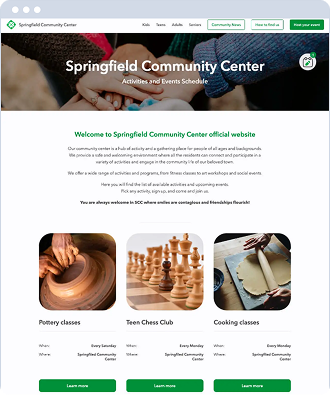
Simply choose a community center template or use AI to create a feature-rich website in a matter of just a few hours. The spreadsheet works as a content management system (CMS) for the platform, which means you can update your service information in just a few clicks by editing your sheet.
SpreadSimple also provides all the features necessary for a community website, including an events grid, activity information, multiple payment options, advanced navigation settings, promo codes, and easy integration with online tools for SEO. With SpreadSimple, you can avoid complex coding and save yourself time and money.
Now that we have our online community center up and running, it is time to spread the word and gather members. There are a variety of marketing strategies that can drive potential audiences to your online venture. Some of the ways to achieve this are:
- Social media marketing – For this type of marketing, businesses need to create a company identification on social media like Facebook and Instagram and target their audiences. They can leverage their content and let interested parties know about the center. Enterprises can also use influencer marketing to build brand loyalty and let it be used as a trust signal for their website.
- Email marketing – Emails are still a very relevant medium for communication with target audiences. Develop a mailing list by adding a sign-up option on the community’s website. Offer special promo codes, referral programs, and other incentives for new joiners on the email. You can also send out regular newsletters, promotions, updates, and upcoming event schedules to this list. Make sure that you are adhering to privacy regulations and laws of the country.
- SEO – SEO is the best marketing strategy to optimize a platform’s SERP ranking on Google. It helps draw organic traffic toward the business while building long-term brand awareness. Some ways to achieve this are by adding meta titles and descriptions for each web page and following other practices like using free Google Analytics and taking advantage of free tools.
- Facebook and Instagram advertisements – The respective platforms offer various strategic ad placements that help communities target certain demographics or interest groups. Facebook and Instagram have also started plugins that can be directly applied to your website dashboard, which optimizes the ads around the clock using AI.
If you are curious to know more ways to market your online website, then refer to our other articles – Ways to Find Customers for Your Product and 10 Free Advertising Platforms to Promote Your Website Online.
Staffing and volunteer management
A community hub needs a great team to monitor, support, and maintain its framework. Developing a successful center requires an ongoing commitment from staff members with a range of skills, each contributing to the growth of the enterprise.
The strength of the community hub lies in the diversity of its team. From volunteers to full-time employees, every person plays a crucial role in bringing the venture's vision to life. So, it is essential to recruit individuals who are not only skilled but also passionate about this type of work. As an executive leader, it is your work to cultivate a culture of respect, inclusivity, and collaboration with one another. This internal harmony will translate into more effective outreach for the community network.
Building a dream team may not be as easy as it sounds, but it is extremely vital to the recreational activity center's success. With the help of a well-trained staff, an ordinary visit by a member can transform into an unforgettable experience. Here are some tips to assemble a stellar squad:
- Purpose-driven recruitment – Find employees with skills and a passion for creating fun community experiences. You can do this by advertising on local job boards, social media platforms, and community centers to attract enthusiastic talent for the business.
- Interviews – Use the interview to assess not only qualifications but also candidates' enthusiasm for teamwork and member interactions. In the meeting, ask scenario-based questions to evaluate their approach to life situations.
- Effective training modules – A constantly growing team ensures the development of the enterprise as well. Create training manuals on safety protocols, activity-based knowledge, customer service, etc. Encourage the new employees to shadow the veterans and experienced staff as it aids in learning.
- Foster a positive environment – Develop a workplace where staff feels valued and appreciated. Do regular team-building exercises and have open communication as it helps to boost morale. Always encourage feedback and acknowledge individuals' achievements.
- Ongoing development – A motivated team naturally enhances member satisfaction. So offer growth opportunities through certifications and workshops.
A supportive staff and lively team will foster a welcoming atmosphere and translate to the growth of the community center.
Monitoring and evaluation
Now that the community center is ready and online, it doesn't mean the work is finished. For any business, regular evaluation and monitoring are key to ensuring the venture meets its goals. What does success look like for your recreational center? You will need some tangible metrics called Key Performance Indicators (KPIs) to measure how the progress of the enterprise is when reaching its goals. Think of them as benchmarks to see how you are faring. They should be SMART – Specific, Measurable, Realistic, and Time-bound. Here are some examples of metrics that can be used:
- User growth – Monitor how fast the community is attracting new members against the marketing strategies.
- Member engagement levels – Track how often audiences are interacting with each other through posts, shared content, discussions, and workshops.
- Community activity – Measure the frequency of participation, contributions, insights, and conversations within the network.
A person can use modern digital tools to monitor the participation rates and engagement levels within the community. Other ways include conducting feedback sessions and surveys with members to understand what is working and what needs to be changed. By watching KPI outcomes like literacy improvements, increased participation, or job placements, we can help demonstrate the center’s impact to investors and institutions. This will aid in securing ongoing funding and support.
Conclusion
Overall, starting a community center business is a very rewarding venture, not just in terms of financial gains but in its power to impact and change people’s lives positively. Let us recap a few key takeaways we learned from the above:
- Understanding the network’s needs and interests is paramount for growth. A successful recreational hub serves as a space for fostering connection, learning, and feelings of togetherness. The enterprise must offer programs and services that resonate with the members and make them feel heard. This can be achieved with the help of monitoring KPIs, conducting surveys, and holding town hall meetings to gain feedback from the community directly.
- Financial planning is extremely vital for smooth operations of the organization. As we mentioned, securing funding through institutions, grants, or loans will be critical in getting the business off the ground. Another important factor is to make sure the business model is sustainable so that it ensures long-term viability. This requires careful budgeting, exploring different revenue streams, and partnering with local organizations for growth.
- Lastly, marketing your community center will play a massive role in its success. Having an online presence is non-negotiable. Here are some useful strategies to keep in mind:
- Create engaging content that centers around the network’s mission and services.
- Use social media platforms to engage with the community at large.
- Leverage local businesses and media outlets for more exposure.
- Host galas and events to create a buzz and attract members.
- Collaborate with other centers, schools, institutions, and stakeholders in your neighborhood.
- Collect testimonials and feedback from participants to improve credibility.
- Offer volunteer opportunities.
Every big change starts with a small step. So, begin laying the foundation today with the help of thorough research, strategic planning, and genuine engagement with your community. Use SpreadSimple to build your community center website and get started.